
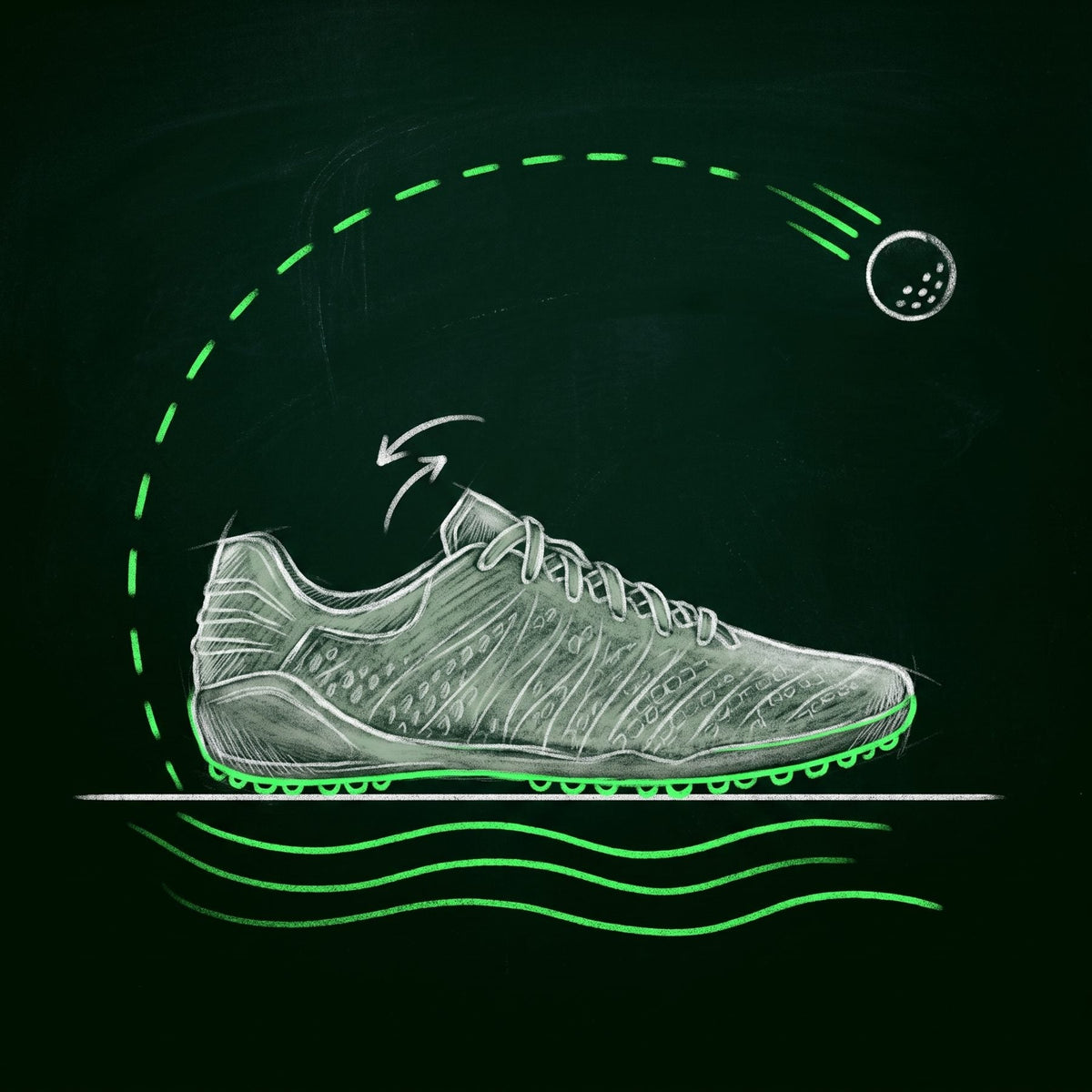
Golfers spend a lot of time on grip, posture and swing plane, and most of that work happens from the waist up. The only thing actually touching the ground during a swing is your feet, and everything the club does has to start with how they push against it.
A biomechanics lab at Texas Woman's University measured exactly that. They put 63 highly skilled golfers on force plates and compared how each foot pushed on the ground with how fast the club was moving. The results show two feet doing two very different jobs, and the golfers who did those jobs harder swung faster.
What they did
All 63 golfers were men with a handicap of 3 or better, a mix of touring pros, college players and teaching pros. They averaged 31 years old and about 184 lb. Each one hit five good shots with a driver, a 5-iron and a pitching wedge, using their own clubs and their own golf shoes, while each foot stood on its own force plate covered with a practice mat.
The force plates recorded how hard each foot pushed down, forward or backward, and toward or away from the target. Motion capture tracked the body and the club. Driver speed averaged about 108 mph, 5-iron about 92 mph and wedge about 84 mph, and the whole swing took roughly one second.
The lead foot takes the load
At the top of the backswing, more of the weight sits on the trail foot. Then, early in the downswing, the lead foot takes over fast. At its peak it was carrying about 1.1 times body weight on its own, around 200 lb for an average golfer in the study. Both feet together peaked at about 1.6 times body weight.
Just before that big push, the golfers briefly got lighter on the ground, dropping to about 0.8 times body weight. It's the same dip you make before a jump. With the irons and the wedge, the golfers who dipped more swung faster.
The lead foot's forces lined up with clubhead speed in every direction the plates measured: down, forward and back, and sideways. The trail foot was different. Only one of its forces mattered.

Both feet push sideways, in opposite directions
That one force was the push along the length of the foot. During the downswing, the lead foot pushes toward the toes and the trail foot pushes toward the heels. The lead foot's push peaked at around 0.28 times body weight, about 50 lb, and had the strongest link to speed of any single force in the study.
Pushing in opposite directions with two feet set apart is what turns the body. The researchers measured that turning effect, and the trail foot's share of it had the strongest relationship with clubhead speed of anything they measured, across all three clubs.
They also measured how much the shoe itself twisted against the ground, like grinding out a cigarette. It turned out to be small, at most about a fifth of the total turning effect. The turn comes from the two feet pushing opposite ways, not from screwing a foot into the turf.

When it happens
The biggest turning effort came early in the downswing, at about the moment the lead arm is parallel to the ground. Getting weight onto the lead foot around that point was key to producing it. The biggest straight-down push came a little later.
The authors describe the pattern as shift, rotate, shift, rotate. Golfers shift away from the target, turn back, shift toward the target, and then turn through.
What to keep in mind
This study shows relationships, not cause and effect, and most of them were moderate. All the golfers were skilled men, so we don't know how well the pattern holds for higher handicaps or for women. They hit foam balls indoors, standing on practice mats over force plates rather than on grass. Each golfer wore his own shoes, so the study doesn't say anything about footwear one way or the other. The researchers also only looked at peak values, and they point out that even elite golfers shift their weight in quite different ways.
What the researchers suggest
The authors' advice for more speed is to produce those big turning forces early in the downswing. Turn the body hard early while keeping the club close, then let the club release late so it has time to accelerate. In practice, that means getting onto your lead foot early instead of hanging back.
How we think about it
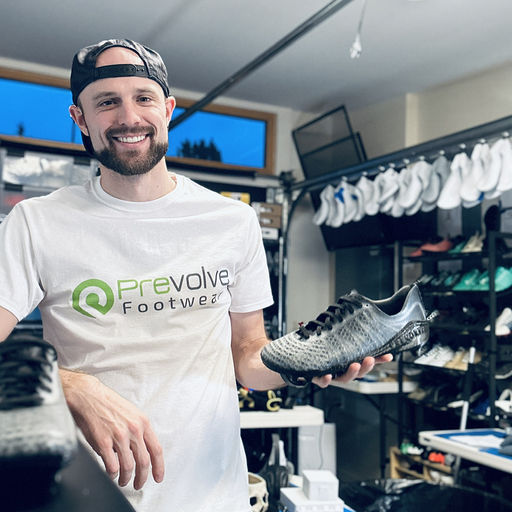
Your two feet do different jobs in the swing. The lead foot takes a large load in every direction, and the trail foot drives the turn with a push toward the heel. That's why every Prevolve golf shoe is built from a scan of each foot separately. Your left and right shoes aren't mirror images of each other, because your feet aren't either.
A push only helps if it reaches the ground. Our shoes are printed to the shape of your foot, so it stays planted inside the shoe through the backswing, transition and impact instead of sliding around. The traction, whether you choose the rubber tread or the screw-in spikes, is placed using your foot's bone structure, so the grip sits under the parts of your foot you actually push from. Pick the rubber tread for most courses and the spikes for wet or hilly ones. The full build is on our custom golf shoe page.

The feet doing that pushing need to be strong as well. Our free foot strength level guide shows you where yours are and how to build them, and the shoe's insole plate is set to the level you're at. If your current shoes squeeze your toes together, you're also standing on a narrower base than your foot is built for. We covered that in the widest golf shoes on the market.
Work on your swing all you like. Just remember it starts with your feet.

Tell us where your feet work hardest
If you play, we'd like to hear from you. Where do you feel your swing in your feet? Does your trail foot slip at the start of the downswing, or does your lead foot roll on wet mornings or uneven lies? Send us a message. We're testing a new screw-in spike plate right now, tester pairs are $250 off, and real feedback from the course shapes where every spike goes.
Cheers,
Oliver
Founder
Prevolve Footwear
Source: Han, K. H., Como, C., Kim, J., Lee, S., Kim, J., Kim, D. K., & Kwon, Y.-H. (2019). Effects of the golfer–ground interaction on clubhead speed in skilled male golfers. Sports Biomechanics, 18(2), 115–134. doi.org/10.1080/14763141.2019.1586983