

3D printing is no longer new, but it is still cool. The core patents for FDM printing, the melt-plastic-one-layer-at-a-time kind, expired in 2009, and a gold rush started that still has not really stopped. By now you have probably seen a printer in person or watched one hypnotically laying down layers on YouTube.
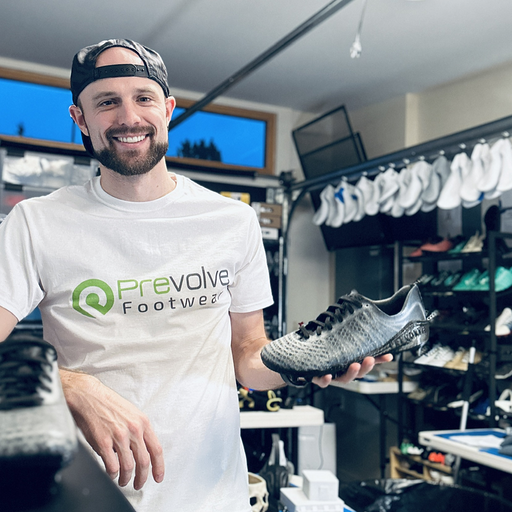
What most people have not seen is 3D printing used for the thing you actually wear. Printing has spent most of its life making prototypes and parts that do not need to survive much. That era is over: with today's printers and materials you can produce real end-use products, like shoes, or fully custom fit cleats.

Every one of these was printed, not molded.
This post is the case for why we build shoes this way, what it actually costs us, and the corner of the internet that taught us most of it.
Why print at all?
- Mass customization. Production-capable machines start under the $1,000 mark, so a factory that produces a high volume of individually customized parts is now something a small company can actually build. Ours lives in Kent, Washington.
- On-demand production. No molds means no inventory. We print your pair when you order it, which means no warehouse of unsold shoes in sizes that fit nobody, and no waste from guessing wrong about demand.
- Constant design improvement. This is the big one for us. A molded design costs a fortune to change, so it does not change. A printed design changes as soon as we learn something. We keep a public log of every improvement we have shipped, roughly a thousand entries and counting, and the pace is only possible because there is no mold standing between an insight and the next pair. This year alone that loop gave every pair laser-cut ripstop backing at the eyelets, a post-print annealing step that made cleat plates stop cracking, and a dual-material insole plate. Each one went from idea to shipping product without retooling anything.
- Design freedom. Printing builds shapes molding physically cannot: internal cavities, lattice structures, parts that are stiff in one direction and soft in another. That is where the interesting shoe engineering lives.

Geometry a mold could never release.
The design side of this story, the algorithm that turns your foot scan into printable geometry, got its own post: The File That Builds Your Shoes.
The honest downsides
3D printing is not free lunch. Five things it makes you pay for:
- Price per part. Always higher than injection molding. Molding pays a huge cost up front and then stamps out parts for pennies; printing pays per part, forever. Custom only works because nobody can mold a one-of-one.
- Overhangs. Any surface without material under it needs support material, which costs time, leaves blemishes, and ends up as waste. Overhangs are arguably the biggest design constraint in printing, and they simply do not exist in molding.
- Layer orientation. Every print has one weak axis, across the layer lines. Part orientation has to keep those lines away from functionally critical areas. Get it wrong and the part fails exactly where it matters. This is also why we anneal cleat plates after printing and torture-test parts in a chest freezer: cold is when printed TPU is at its most brittle, and we would rather find the weak layer than have you find it.
- Material limits. Not every molding material has a printable equivalent. Printable materials have to melt and fuse in a way that produces consistent strength.
- Speed. A mold can spit out a part in seconds. A printer takes hours. We buy that time back with a fleet, not with shortcuts.

Hours per part. Worth it when the part is yours.
The people who taught us
We figured out a lot on our own, but these channels deserve real credit for the rest, and each has a genuinely different angle:
Slant 3D, founded by Gabe Bentz in Idaho, is our favorite for designing parts for end-use printing and for how printing changes the whole manufacturing landscape.
CNC Kitchen, Stefan Hermann, has spent years publishing the kind of detailed testing data, on temperatures, strength, and materials, that a company like ours would otherwise have to generate itself.
Made with Layers, Thomas Sanladerer, is one of the oldest heads in the game: reviews with real depth, plus filament testing, reliability, and safety work.
Shop Nation and Print Farm Academy, both from Travis Lathrop, cover using 3D printing to actually run a business, including how to set up a print farm properly.
A good moment in that world: Gabe hosted Travis on his podcast, worth a listen. Our favorite point from it is one we live: because printed designs are just files, a manufacturer can take responsibility for its product and fix it when customers report problems, instead of shrugging at an aluminum mold. Thomas and Stefan also run their own podcast, The Meltzone.
For industry news, 3D Natives is the one we check.

The printers we rate in 2026
Bambu Lab still sets the pace in the print farm category. Their current H2D and X2D generation machines are the speed and reliability benchmark everyone else is chasing.
Prusa was the one who first made production printing reliable, with the long-running MK series, and they have answered the Bambu era with the fully enclosed CORE One. Their multimaterial XL remains a genuinely different tool for multi-material parts.
Elegoo is still the budget answer, and the gap is closing: the Centauri Carbon gives you an enclosed, fast machine for a few hundred dollars.
Why this matters for your feet
Everything above is why a company our size can make fully custom fit, fully 3D printed footwear (except the laces) and improve it every single month. Accelerated development, mass customization, geometry molds cannot make, on-demand production, and low up-front cost: that is the whole toolkit, pointed at the one product where a perfect individual fit matters most.

Printed, assembled by hand, improved by the next order's feedback.