Free U.S.A. Shipping on all orders

The five foot functions.
A sensation-generating machine.
Your foot has about 4,000 touch sensors in each sole, packed most densely in your toes. They report pressure, texture, slip and surface angle, and they feed your proprioception: your body's sense of where it is in space. That stream of information keeps you balanced and in control through a hard cut, a bad landing or a random hole in the ground.
Traditional footwear: A stiff or overly cushioned shoe prevents all of that. If you can't feel, you can't balance. If you can't balance, say goodbye to your ankles.
How Prevolve builds: There's a trade-off between cushion and sensation. Some sports demand more cushion, some less. Your foot strength matters just as much. The stronger your foot, the less cushioning it needs from the shoe. Not sure how strong yours are? Take the free foot assessment to find out. Prevolve builds your insole and outsole as thin as your sport and your foot strength allow, and lets the ground talk to your foot.
Your insole doesn't just adapt in thickness. Your insole plate adapts in stiffness too, on the same principle: the stronger your foot and the lighter your weight, the thinner and more flexible the plate.
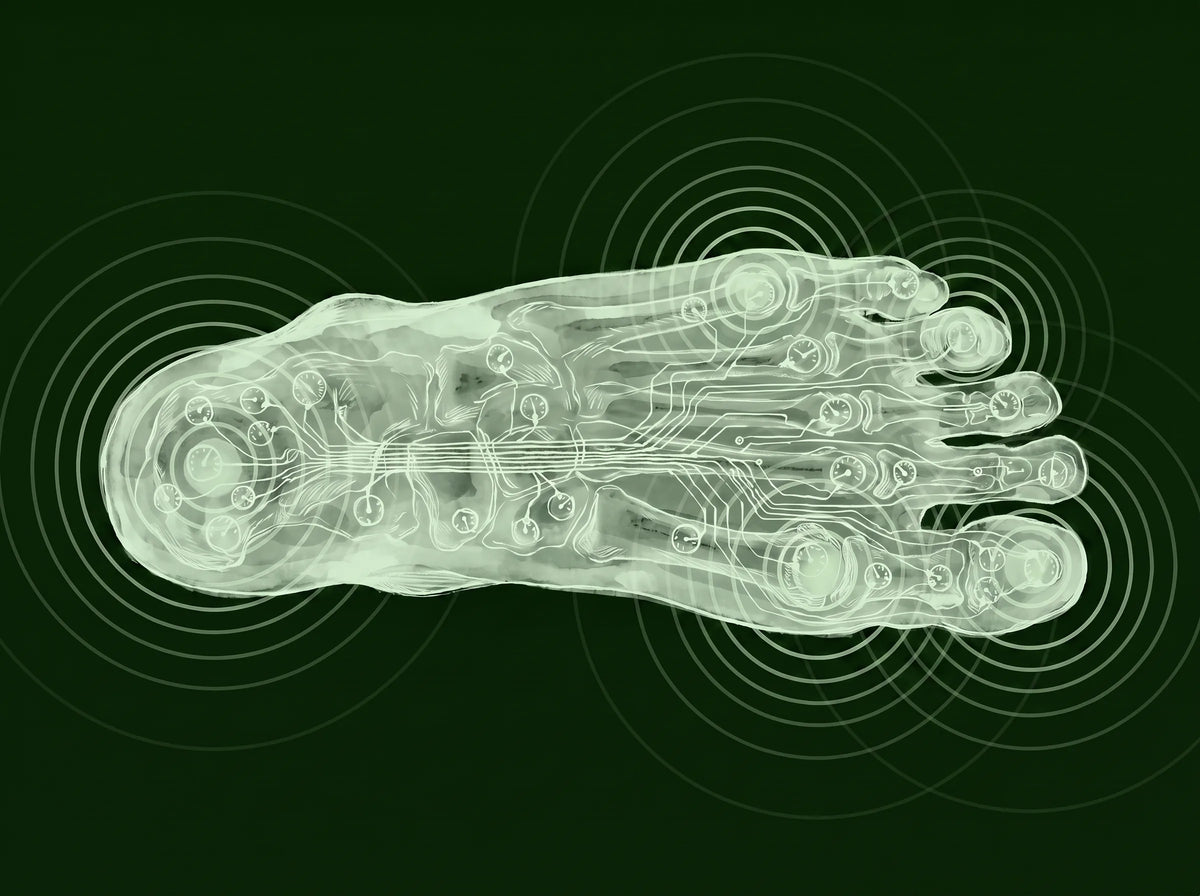
A sensation-generating machine.
Your foot has about 4,000 touch sensors in each sole, packed most densely in your toes. They report pressure, texture, slip and surface angle, and they feed your proprioception: your body's sense of where it is in space. That stream of information keeps you balanced and in control through a hard cut, a bad landing or a random hole in the ground.
Traditional footwear: A stiff or overly cushioned shoe prevents all of that. If you can't feel, you can't balance. If you can't balance, say goodbye to your ankles.
How Prevolve builds: There's a trade-off between cushion and sensation. Some sports demand more cushion, some less. Your foot strength matters just as much. The stronger your foot, the less cushioning it needs from the shoe. Not sure how strong yours are? Take the free foot assessment to find out. Prevolve builds your insole and outsole as thin as your sport and your foot strength allow, and lets the ground talk to your foot.
Your insole doesn't just adapt in thickness. Your insole plate adapts in stiffness too, on the same principle: the stronger your foot and the lighter your weight, the thinner and more flexible the plate.
Width is function, not just comfort.
When you load your foot, the toes are meant to spread. Look at the long bones running through the middle of your foot: your toes should follow those same lines, not kink away from them. The big toe and the pinky toe are the ones most likely to kink after years in narrow shoes, and once a toe is bent out of line with its joint, the muscles that move it can't do their job. It shows in the research: people who wear minimal shoes have bigger muscles at both of those toes, and higher, stiffer arches.
Traditional footwear: Most shoes have a narrow toe box. Partly that's tradition and looks, and partly it makes shoes easier to assemble. Pointed toes were once a status symbol, too: a narrow toe slid easily into a stirrup, and owning a horse meant money.
How Prevolve builds: Your toe box is built from your actual foot shape, blended with a toe box shape designed for your sport. The stronger your feet, the more width we add, because stronger feet and toes can put more splay to use. We also highly recommend toe spacers to fill the gaps between your toes, so they don't slip while you relearn how to splay.
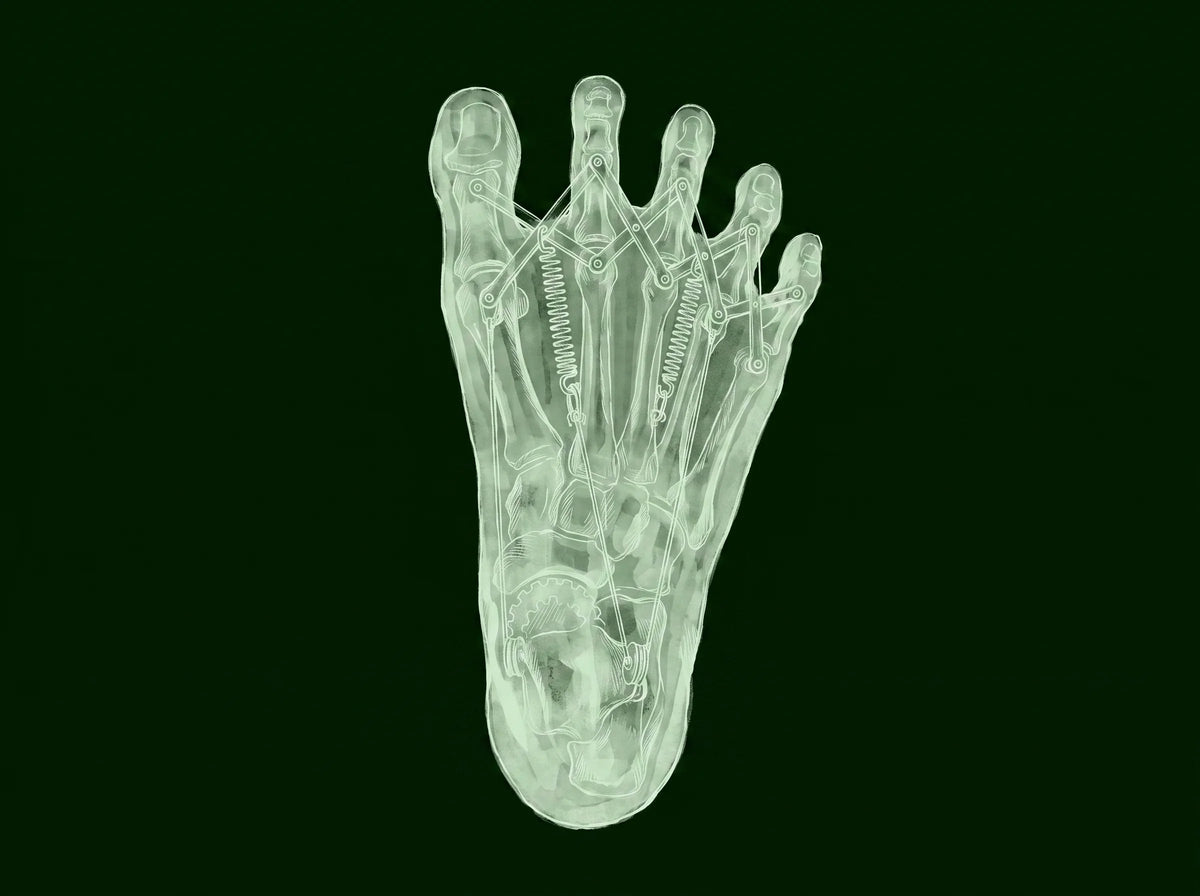
Width is function, not just comfort.
When you load your foot, the toes are meant to spread. Look at the long bones running through the middle of your foot: your toes should follow those same lines, not kink away from them. The big toe and the pinky toe are the ones most likely to kink after years in narrow shoes, and once a toe is bent out of line with its joint, the muscles that move it can't do their job. It shows in the research: people who wear minimal shoes have bigger muscles at both of those toes, and higher, stiffer arches.
Traditional footwear: Most shoes have a narrow toe box. Partly that's tradition and looks, and partly it makes shoes easier to assemble. Pointed toes were once a status symbol, too: a narrow toe slid easily into a stirrup, and owning a horse meant money.
How Prevolve builds: Your toe box is built from your actual foot shape, blended with a toe box shape designed for your sport. The stronger your feet, the more width we add, because stronger feet and toes can put more splay to use. We also highly recommend toe spacers to fill the gaps between your toes, so they don't slip while you relearn how to splay.
The arch is the spring of the catapult.
Your three arches, working with the plantar fascia and the Achilles, form an elastic system. It compresses as you land, stores that energy and returns it as you push off: the arch alone stores and returns roughly 17% of the mechanical energy of running (Ker and colleagues, Nature, 1987). The engine is your calf. It holds nearly still while the Achilles stretches and recoils like a catapult being drawn and released, and that recoil supplies up to three quarters of the positive work of the calf and Achilles together.
Traditional footwear: Arch supports and stiff shanks hold the arch up so it never has to flex. That takes the load off the tissue, and with it the stimulus that keeps the spring strong. A spring that never stretches stops being a spring.
How Prevolve builds: We don't build in arch support. Your insole follows the shape of your own foot from your scan, and the plate's stiffness is tuned to your weight and foot strength, so your arch can load, flex and recoil the way it was built to. Every pair is zero drop, so your heel sits level with your forefoot, just like it does barefoot. Want more under the ball of your foot? Our custom-fit metpads come in five levels, shaped from your scan.
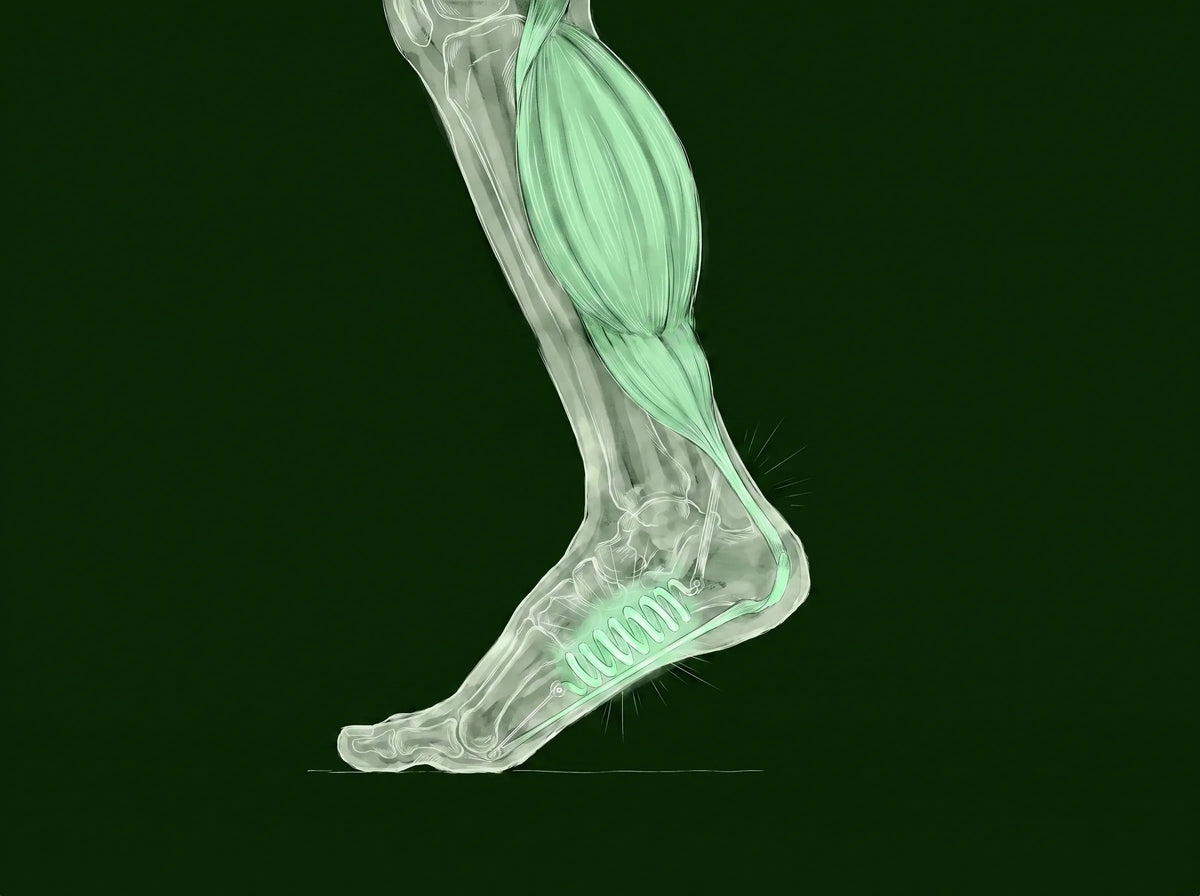
The arch is the spring of the catapult.
Your three arches, working with the plantar fascia and the Achilles, form an elastic system. It compresses as you land, stores that energy and returns it as you push off: the arch alone stores and returns roughly 17% of the mechanical energy of running (Ker and colleagues, Nature, 1987). The engine is your calf. It holds nearly still while the Achilles stretches and recoils like a catapult being drawn and released, and that recoil supplies up to three quarters of the positive work of the calf and Achilles together.
Traditional footwear: Arch supports and stiff shanks hold the arch up so it never has to flex. That takes the load off the tissue, and with it the stimulus that keeps the spring strong. A spring that never stretches stops being a spring.
How Prevolve builds: We don't build in arch support. Your insole follows the shape of your own foot from your scan, and the plate's stiffness is tuned to your weight and foot strength, so your arch can load, flex and recoil the way it was built to. Every pair is zero drop, so your heel sits level with your forefoot, just like it does barefoot. Want more under the ball of your foot? Our custom-fit metpads come in five levels, shaped from your scan.
Force leaves your body through your toes.
The toes are not along for the ride. Measured across 160 people, they are in ground contact for about three-quarters of the stance phase, with peak pressures comparable to the metatarsal heads. They are also trainable, and it shows up in performance: seven weeks of toe-flexor training roughly doubled joint strength and added 6cm to a standing jump, and in collegiate American football players, toe-pushing force tracked with pro-agility and 3-cone times (though not with straight-line sprint). The toe joint is the last link between the big muscles generating force and the ground they push against.
Traditional footwear: Stiff plates, upturned toes and cramped toe boxes turn your toes into passengers. Toes that can't press into the ground waste what your hips produce.
How Prevolve builds: Your toe box follows your real toe shape, so every toe gets its own room and its own contact with the ground. The plate's stiffness is tuned to your weight and foot strength, so your toes do the pushing instead of riding on a rigid lever. Add custom-fit toe spacers to keep each toe in its own lane while it relearns to push.
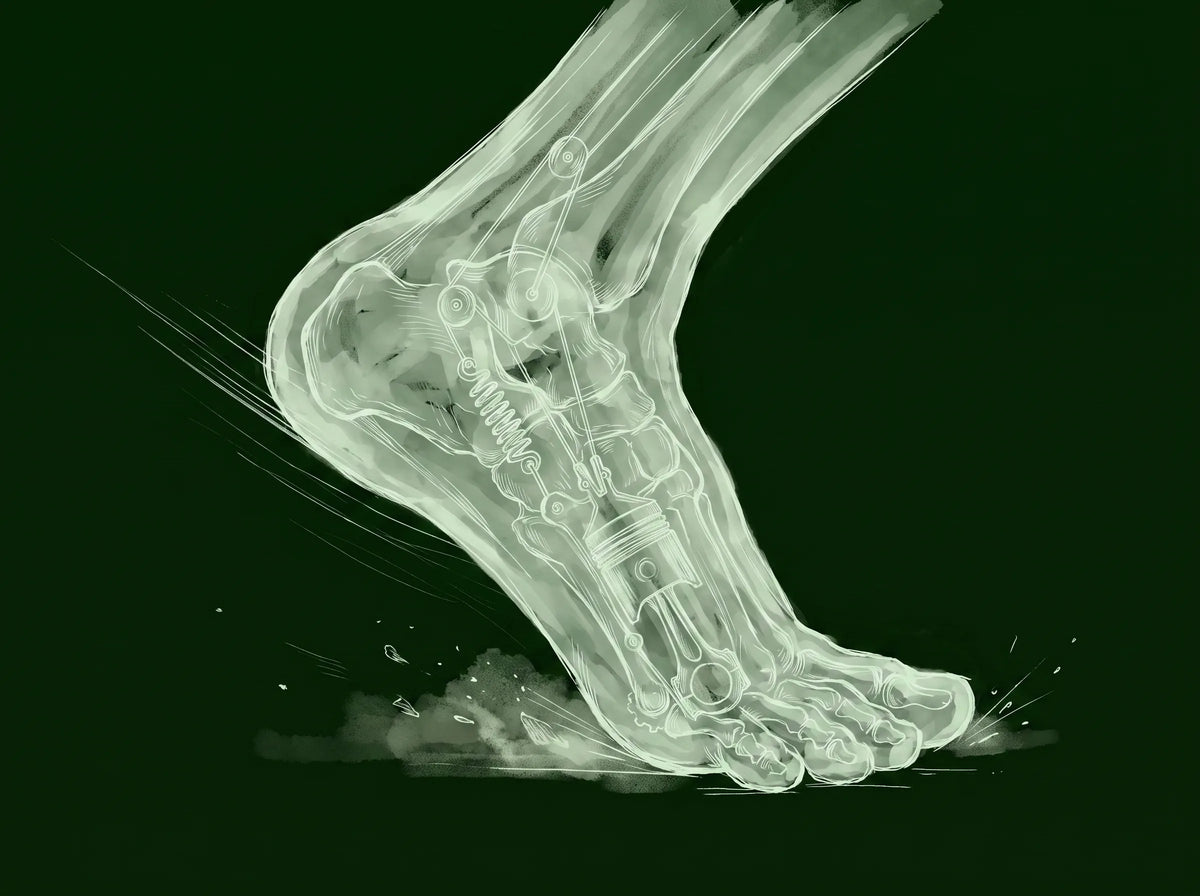
Force leaves your body through your toes.
The toes are not along for the ride. Measured across 160 people, they are in ground contact for about three-quarters of the stance phase, with peak pressures comparable to the metatarsal heads. They are also trainable, and it shows up in performance: seven weeks of toe-flexor training roughly doubled joint strength and added 6cm to a standing jump, and in collegiate American football players, toe-pushing force tracked with pro-agility and 3-cone times (though not with straight-line sprint). The toe joint is the last link between the big muscles generating force and the ground they push against.
Traditional footwear: Stiff plates, upturned toes and cramped toe boxes turn your toes into passengers. Toes that can't press into the ground waste what your hips produce.
How Prevolve builds: Your toe box follows your real toe shape, so every toe gets its own room and its own contact with the ground. The plate's stiffness is tuned to your weight and foot strength, so your toes do the pushing instead of riding on a rigid lever. Add custom-fit toe spacers to keep each toe in its own lane while it relearns to push.
Feet respond to load like any other muscle.
Six months of ordinary daily activity in minimal footwear increased foot strength by an average of 57%, from everyday wear rather than training. In a separate randomised trial of 57 runners, simply walking in minimalist shoes was as effective as doing dedicated foot-strengthening exercises: both groups gained muscle size and strength over eight weeks, and the control group gained nothing.
Traditional footwear: A shoe that does the work for your feet never asks them to adapt. The cushion, the support and the stiffness stay the same forever, so your feet do too.
How Prevolve builds: Every pair starts from your foot strength level, and comes with a free foot assessment and training program. As your foot strength climbs, your next pair is built thinner and more flexible to match. Go gradually: adaptation takes time you can't skip, and injury is what skipping looks like.

Feet respond to load like any other muscle.
Six months of ordinary daily activity in minimal footwear increased foot strength by an average of 57%, from everyday wear rather than training. In a separate randomised trial of 57 runners, simply walking in minimalist shoes was as effective as doing dedicated foot-strengthening exercises: both groups gained muscle size and strength over eight weeks, and the control group gained nothing.
Traditional footwear: A shoe that does the work for your feet never asks them to adapt. The cushion, the support and the stiffness stay the same forever, so your feet do too.
How Prevolve builds: Every pair starts from your foot strength level, and comes with a free foot assessment and training program. As your foot strength climbs, your next pair is built thinner and more flexible to match. Go gradually: adaptation takes time you can't skip, and injury is what skipping looks like.
0
Bunions found in a 1949 survey of 5,128 people who had never worn shoes.
0 is a big number.¹⁴
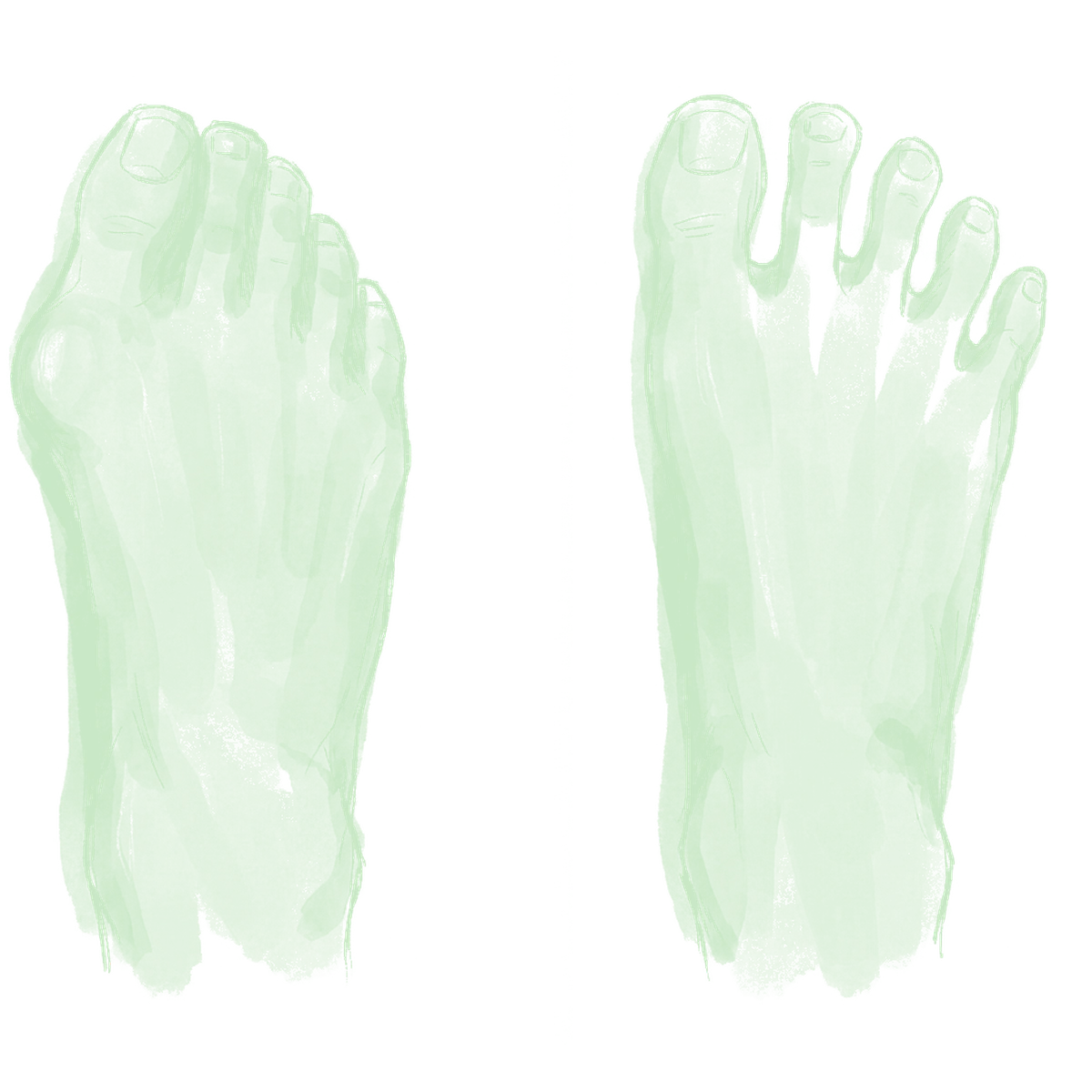
The big toe is a big deal.
It's not really genetic.
At the end of every stride, the last point of contact should be your big toe. Most of the power your body generates starts in the glutes, and it ends at the big toe. If that toe is bent inward at the moment of push-off, energy leaks away at the very last link. The ball of the big toe is also one of the three contact points that make up your foot's tripod, along with the ball of the little toe and the heel, so balance and good mechanics depend on it sitting in line. For a lot of athletes moving from traditional footwear to minimal, relearning to engage the big toe is the single biggest unlock.
Traditional footwear: Bunions run in families, but what you inherit is mostly your foot shape. A wide forefoot jammed into a narrow toe box has the furthest to bend, so that is where bunions show up first. The root cause is the shoe, and feet that never wore shoes prove it: children raised barefoot have higher arches and straighter big toes than shod peers of the same age and background,¹² and barefoot adults have wider feet, widest across the toes.¹³ It's not your foot's fault.
How Prevolve builds: Your toe box is built from your own foot shape, blended with a toe shape designed for your sport, so your big toe isn't squeezed inward. Splay is trainable, too: give the toes room, load them, and optionally hold the space with toe spacers printed from your own scan. The evidence supports spacers combined with exercise, not as a standalone fix, which is why ours ship pointing you to the training plan.
The big toe is a big deal.
It's not really genetic.
At the end of every stride, the last point of contact should be your big toe. Most of the power your body generates starts in the glutes, and it ends at the big toe. If that toe is bent inward at the moment of push-off, energy leaks away at the very last link. The ball of the big toe is also one of the three contact points that make up your foot's tripod, along with the ball of the little toe and the heel, so balance and good mechanics depend on it sitting in line. For a lot of athletes moving from traditional footwear to minimal, relearning to engage the big toe is the single biggest unlock.
Traditional footwear: Bunions run in families, but what you inherit is mostly your foot shape. A wide forefoot jammed into a narrow toe box has the furthest to bend, so that is where bunions show up first. The root cause is the shoe, and feet that never wore shoes prove it: children raised barefoot have higher arches and straighter big toes than shod peers of the same age and background,¹² and barefoot adults have wider feet, widest across the toes.¹³ It's not your foot's fault.
How Prevolve builds: Your toe box is built from your own foot shape, blended with a toe shape designed for your sport, so your big toe isn't squeezed inward. Splay is trainable, too: give the toes room, load them, and optionally hold the space with toe spacers printed from your own scan. The evidence supports spacers combined with exercise, not as a standalone fix, which is why ours ship pointing you to the training plan.
0
Bunions found in a 1949 survey of 5,128 people who had never worn shoes.
0 is a big number.¹⁴
No two feet are the same.
Get your feet scannedWhat 1.2 million scans show.
Volumental, the scanner behind our foot scans, published an analysis of 1.2 million 3D foot scans. Among people whose feet are the same length, the middle 90% span 16 mm of width, and one stock width fits at most 40% of them. Most shoes are sold in exactly one width.⁷
And it shows up on real feet.
Reviews of fitting studies find 63 to 72% of people in shoes that do not match their foot's length or width.⁸ Among people whose shoes mismatch their feet, 60% also have at least a half-size difference between their own left and right foot.⁹ Fit is not a detail of footwear. It is the product.
40%
The most people one stock shoe width can fit, within a single size⁷.
72%
Of people wear shoes that do not match their foot's length or width⁸.
60%
Of mismatched-shoe wearers also have different-sized left and right feet⁹.
Going minimal takes time.
Sensation takes time, and the nervous system is often numb when people start.
The cautionary tale.
In a 2013 study, 36 experienced runners moved to minimalist shoes over ten weeks — gradually, by design. MRI scans afterwards found increased bone marrow edema in 10 of the 19 who switched, against 1 of 17 who stayed in traditional shoes. On the scale used, the top score is a stress fracture.
That is not an argument against minimal footwear. It is an argument against arriving unprepared.
The cushioning trap.
There is a second trap worth naming. Cushioning does not make you land softer. When researchers put runners in highly cushioned shoes, their legs stiffened on landing and impact loading went up — 10–12% higher at speed — not down. Years of that landing pattern are exactly what a transition has to unlearn. You do not get the warning until the damage is already done.
This is the entire reason the Foot Assessment exists. It puts a number on where your feet actually are, and gives you the ramp that matches it.
The cautionary tale.
In a 2013 study, 36 experienced runners moved to minimalist shoes over ten weeks — gradually, by design. MRI scans afterwards found increased bone marrow edema in 10 of the 19 who switched, against 1 of 17 who stayed in traditional shoes. On the scale used, the top score is a stress fracture.
That is not an argument against minimal footwear. It is an argument against arriving unprepared.
The cushioning trap.
There is a second trap worth naming. Cushioning does not make you land softer. When researchers put runners in highly cushioned shoes, their legs stiffened on landing and impact loading went up — 10–12% higher at speed — not down. Years of that landing pattern are exactly what a transition has to unlearn. You do not get the warning until the damage is already done.
This is the entire reason the Foot Assessment exists. It puts a number on where your feet actually are, and gives you the ramp that matches it.
Short exposures, full recovery.
Wear time measured in hours, not sessions. Everything feels fine at this stage — which is exactly why people overshoot.
Load goes up, slowly.
The window your 6-week training program covers. Some arch and calf fatigue is expected and is the point. Sharp or localised bone pain is not — that distinction matters more than any schedule.
Training in them properly.
Muscle size and strength are measurably changing by around week 8 in the trial data. Full sessions become realistic.
Adapted.
The +57% mark in the trial data, reached on everyday wear alone. Deliberate training keeps building from here.
Short exposures, full recovery.
Wear time measured in hours, not sessions. Everything feels fine at this stage — which is exactly why people overshoot.
Load goes up, slowly.
The window your 6-week training program covers. Some arch and calf fatigue is expected and is the point. Sharp or localised bone pain is not — that distinction matters more than any schedule.
Training in them properly.
Muscle size and strength are measurably changing by around week 8 in the trial data. Full sessions become realistic.
Adapted.
The +57% mark in the trial data, reached on everyday wear alone. Deliberate training keeps building from here.
6
Foot strength levels, from Foundations to Elite feet.
The Foot Assessment scores your feet across foot condition, toe strength and mobility, squat and balance, puts you on a level, and hands you the 6-week training program written for it. Free, plus $100 off any pair of custom boots or shoes.
6
Foot strength levels, from Foundations to Elite feet.
The Foot Assessment scores your feet across foot condition, toe strength and mobility, squat and balance, puts you on a level, and hands you the 6-week training program written for it. Free, plus $100 off any pair of custom boots or shoes.
Fair questions.
References.
Curtis R, Willems C, Paoletti P, D'Août K. Daily activity in minimal footwear increases foot strength. Sci Rep. 2021;11(1):18648. PMID: 34545114.
Ridge ST, Olsen MT, Bruening DA, Jurgensmeier K, Griffin D, Davis IS, Johnson AW. Walking in minimalist shoes is effective for strengthening foot muscles. Med Sci Sports Exerc. 2019;51(1):104–113. PMID: 30113521.
Holowka NB, Wallace IJ, Lieberman DE. Foot strength and stiffness are related to footwear use in a comparison of minimally- vs. conventionally-shod populations. Sci Rep. 2018;8(1):3679. PMID: 29487321.
Ker RF, Bennett MB, Bibby SR, Kester RC, Alexander RM. The spring in the arch of the human foot. Nature. 1987;325:147–149. PMID: 3808070.
Fukunaga T, Kubo K, Kawakami Y, Fukashiro S, Kanehisa H, Maganaris CN. In vivo behaviour of human muscle tendon during walking. Proc Biol Sci. 2001;268(1464):229–233. PMID: 11217891.
Lai A, Schache AG, Lin YC, Pandy MG. Tendon elastic strain energy in the human ankle plantar-flexors and its role with increased running speed. J Exp Biol. 2014;217(17):3159–3168. PMID: 24948642.
McKeon PO, Hertel J, Bramble D, Davis I. The foot core system: a new paradigm for understanding intrinsic foot muscle function. Br J Sports Med. 2015;49(5):290. PMID: 24659509.
Jurca A, Žabkar J, Džeroski S. Analysis of 1.2 million foot scans from North America, Europe and Asia. Sci Rep. 2019;9:19155. PMID: 31844106.
Buldt AK, Menz HB. Incorrectly fitted footwear, foot pain and foot disorders. J Foot Ankle Res. 2018;11:43. PMID: 30065787.
Chen X, et al. Foot and shoe size mismatch in three different New York City populations. J Foot Ankle Surg. 2011. PMID: 21616688.
Nix S, Smith M, Vicenzino B. Prevalence of hallux valgus in the general population: a systematic review and meta-analysis. J Foot Ankle Res. 2010;3:21. PMID: 20868524.
Hughes J, Clark P, Klenerman L. The importance of the toes in walking. J Bone Joint Surg Br. 1990;72(2):245–251. PMID: 2312564.
Goldmann JP, Sanno M, Willwacher S, Heinrich K, Brüggemann GP. The potential of toe flexor muscles to enhance performance. J Sports Sci. 2013;31(4):424–433. PMID: 23106289.
Yamauchi J, Koyama K. Importance of toe flexor strength in vertical jump performance. J Biomech. 2020;104:109719. PMID: 32173032.
Yuasa Y, Kurihara T, Isaka T. Relationship between toe muscular strength and the ability to change direction in athletes. J Hum Kinet. 2018;64:47–55. PMID: 30429898.
Ridge ST, Johnson AW, Mitchell UH, Hunter I, Robinson E, Rich BSE, Brown SD. Foot bone marrow edema after a 10-wk transition to minimalist running shoes. Med Sci Sports Exerc. 2013;45(7):1363–1368. PMID: 23439417.
Zech A, Argubi-Wollesen A, Rahlf AL. Minimalist, standard and no footwear on static and dynamic postural stability following jump landing. Eur J Sport Sci. 2015;15(4):279–285. PMID: 25010996.
Viseux F, Lemaire A, Barbier F, Charpentier P, Leteneur S, Villeneuve P. How can the stimulation of plantar cutaneous receptors improve postural control? Neurophysiol Clin. 2019;49(3):263–268. PMID: 30639034.
Corniani G, Saal HP. Tactile innervation densities across the whole body. J Neurophysiol. 2020;124(4). doi:10.1152/jn.00313.2020.
Kulmala JP, Kosonen J, Nurminen J, Avela J. Running in highly cushioned shoes increases leg stiffness and amplifies impact loading. Sci Rep. 2018;8(1):17496. PMID: 30504822.
Rodríguez-Longobardo C, Gómez-Ruano MÁ, Canosa-Carro L. Effects of barefoot and minimalist footwear strength-oriented training on foot structure and function in athletic populations: a systematic review. J Clin Med. 2025;14(21). PMID: 41227025.
Jiao Y, Džeroski S, Jurca A. Analysis of hallux valgus angles automatically extracted from 3D foot scans. Ergonomics. 2023;66(8):1164–1175. PMID: 36269073.
Hollander K, et al. Growing-up (habitually) barefoot influences the development of foot and arch morphology in children and adolescents. Sci Rep. 2017;7:8079. PMID: 28808276.
D'Août K, et al. The effects of habitual footwear use: foot shape and function in native barefoot walkers. Footwear Sci. 2009;1(2):81–94.
Shulman SB. Survey in China and India of feet that have never worn shoes. J Natl Assoc Chiropodists. 1949;49:26–30.
Curtis R, Willems C, Paoletti P, D'Août K. Daily activity in minimal footwear increases foot strength. Sci Rep. 2021;11(1):18648. PMID: 34545114.
Ridge ST, Olsen MT, Bruening DA, Jurgensmeier K, Griffin D, Davis IS, Johnson AW. Walking in minimalist shoes is effective for strengthening foot muscles. Med Sci Sports Exerc. 2019;51(1):104–113. PMID: 30113521.
Holowka NB, Wallace IJ, Lieberman DE. Foot strength and stiffness are related to footwear use in a comparison of minimally- vs. conventionally-shod populations. Sci Rep. 2018;8(1):3679. PMID: 29487321.
Ker RF, Bennett MB, Bibby SR, Kester RC, Alexander RM. The spring in the arch of the human foot. Nature. 1987;325:147–149. PMID: 3808070.
Fukunaga T, Kubo K, Kawakami Y, Fukashiro S, Kanehisa H, Maganaris CN. In vivo behaviour of human muscle tendon during walking. Proc Biol Sci. 2001;268(1464):229–233. PMID: 11217891.
Lai A, Schache AG, Lin YC, Pandy MG. Tendon elastic strain energy in the human ankle plantar-flexors and its role with increased running speed. J Exp Biol. 2014;217(17):3159–3168. PMID: 24948642.
McKeon PO, Hertel J, Bramble D, Davis I. The foot core system: a new paradigm for understanding intrinsic foot muscle function. Br J Sports Med. 2015;49(5):290. PMID: 24659509.
Jurca A, Žabkar J, Džeroski S. Analysis of 1.2 million foot scans from North America, Europe and Asia. Sci Rep. 2019;9:19155. PMID: 31844106.
Buldt AK, Menz HB. Incorrectly fitted footwear, foot pain and foot disorders. J Foot Ankle Res. 2018;11:43. PMID: 30065787.
Chen X, et al. Foot and shoe size mismatch in three different New York City populations. J Foot Ankle Surg. 2011. PMID: 21616688.
Nix S, Smith M, Vicenzino B. Prevalence of hallux valgus in the general population: a systematic review and meta-analysis. J Foot Ankle Res. 2010;3:21. PMID: 20868524.
Hughes J, Clark P, Klenerman L. The importance of the toes in walking. J Bone Joint Surg Br. 1990;72(2):245–251. PMID: 2312564.
Goldmann JP, Sanno M, Willwacher S, Heinrich K, Brüggemann GP. The potential of toe flexor muscles to enhance performance. J Sports Sci. 2013;31(4):424–433. PMID: 23106289.
Yamauchi J, Koyama K. Importance of toe flexor strength in vertical jump performance. J Biomech. 2020;104:109719. PMID: 32173032.
Yuasa Y, Kurihara T, Isaka T. Relationship between toe muscular strength and the ability to change direction in athletes. J Hum Kinet. 2018;64:47–55. PMID: 30429898.
Ridge ST, Johnson AW, Mitchell UH, Hunter I, Robinson E, Rich BSE, Brown SD. Foot bone marrow edema after a 10-wk transition to minimalist running shoes. Med Sci Sports Exerc. 2013;45(7):1363–1368. PMID: 23439417.
Zech A, Argubi-Wollesen A, Rahlf AL. Minimalist, standard and no footwear on static and dynamic postural stability following jump landing. Eur J Sport Sci. 2015;15(4):279–285. PMID: 25010996.
Viseux F, Lemaire A, Barbier F, Charpentier P, Leteneur S, Villeneuve P. How can the stimulation of plantar cutaneous receptors improve postural control? Neurophysiol Clin. 2019;49(3):263–268. PMID: 30639034.
Corniani G, Saal HP. Tactile innervation densities across the whole body. J Neurophysiol. 2020;124(4). doi:10.1152/jn.00313.2020.
Kulmala JP, Kosonen J, Nurminen J, Avela J. Running in highly cushioned shoes increases leg stiffness and amplifies impact loading. Sci Rep. 2018;8(1):17496. PMID: 30504822.
Rodríguez-Longobardo C, Gómez-Ruano MÁ, Canosa-Carro L. Effects of barefoot and minimalist footwear strength-oriented training on foot structure and function in athletic populations: a systematic review. J Clin Med. 2025;14(21). PMID: 41227025.
Jiao Y, Džeroski S, Jurca A. Analysis of hallux valgus angles automatically extracted from 3D foot scans. Ergonomics. 2023;66(8):1164–1175. PMID: 36269073.
Hollander K, et al. Growing-up (habitually) barefoot influences the development of foot and arch morphology in children and adolescents. Sci Rep. 2017;7:8079. PMID: 28808276.
D'Août K, et al. The effects of habitual footwear use: foot shape and function in native barefoot walkers. Footwear Sci. 2009;1(2):81–94.
Shulman SB. Survey in China and India of feet that have never worn shoes. J Natl Assoc Chiropodists. 1949;49:26–30.
Further reading.
Some of the clearest plain-language writing on foot function and barefoot footwear is Anya’s Reviews. A few pieces that pair well with this page:
The barefoot shoes FAQ Sixty-plus plain answers on toe boxes, zero drop, and transitioning.
Shoes for your foot type Her Slope, Mountain, Plateau, and Square toe-shape guide, the field taxonomy behind the toe-box insight on your account page.
Walking 101 Natural gait from heel contact to big-toe push-off.
Why arch support is not a long-term fix The bracing analogy for arch support, told straight.
Why barefoot shoes are not the full solution Movement matters as much as footwear. We agree.
Do kids need to transition? Short answer: no. Young feet have not spent years in narrow shoes, which is why kids skip the foot-strength question when ordering.
Some of the clearest plain-language writing on foot function and barefoot footwear is Anya’s Reviews. A few pieces that pair well with this page:
The barefoot shoes FAQ Sixty-plus plain answers on toe boxes, zero drop, and transitioning.
Shoes for your foot type Her Slope, Mountain, Plateau, and Square toe-shape guide, the field taxonomy behind the toe-box insight on your account page.
Walking 101 Natural gait from heel contact to big-toe push-off.
Why arch support is not a long-term fix The bracing analogy for arch support, told straight.
Why barefoot shoes are not the full solution Movement matters as much as footwear. We agree.
Do kids need to transition? Short answer: no. Young feet have not spent years in narrow shoes, which is why kids skip the foot-strength question when ordering.
Designed by AthLast™
Find out where your feet actually are, and get $100 off any pair of custom boots or shoes.
Designed by AthLast™