
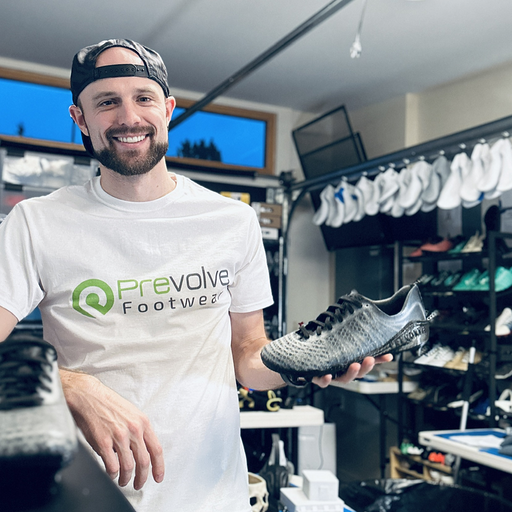

Look at a cleat next to a foot sometime. Not a marketing photo, an actual outsole against an actual foot. They are not the same shape, and the gap is not subtle. Most cleats on the market taper hard through the toe box, and that is not a minor inconvenience: narrow toe boxes cause real foot health problems and real injuries.

Trace a cleat's outsole and trace a foot. They stop agreeing somewhere around the toes.
If you have wide feet, this is obviously worse. But it is not only a wide-foot problem. The human foot has 26 bones, 33 joints, and over a hundred muscles, tendons, and ligaments. That is a lot of unique geometry to compress into one mold, and no conventional shoe manufacturer builds a cleat shape that actually accounts for your specific foot and how it moves, because the manufacturing model was never built to.

We start from your actual feet, a 3D scan, not an assumed average.
That is the problem we built BioCleats to solve: custom fit to your exact foot shape and athletic profile, with custom toe spacers, metpads, and colorways to match. Which raises the obvious question. If this works, why doesn't everyone build shoes this way?

The Red Run colorway, one of many ways a custom-fit cleat can still look sharp.
The cold hard facts
A few reasons the big brands keep shipping narrow shapes, none of them about you:
- Mass production constraints. Manufacturing at scale means designing for an average foot, and averaging a hundred different foot shapes down to one mold pulls the toe box narrower than almost anyone's actual foot.
- Manufacturing simplification. Pulling the last, the internal form used to shape a shoe, out after assembly is easier with a narrower toe box. Easier for the factory, not for your foot.
- Shelf appeal. Success gets measured in units sold, not in foot health outcomes. A sleek, narrow silhouette photographs better than a wide one, even when the wide one is the healthier shoe.
None of those reasons have anything to do with your health or your athletic longevity. A cookie-cutter, mass-produced shoe was never going to meet the demands of your specific body.
The Prevolve approach
BioCleats take the other path: foot health and performance first, mass-market appeal wherever it doesn't get in the way.

Which one of these looks more like a foot?
Here is how we actually build them:
- Custom fit for every foot. Each pair is made to order from your exact dimensions, foot length, toe shape, forefoot width, and more, all sourced from foot scans that take about two minutes, then confirmed with foot verification photos before we build anything.
- 3D printed for quick customization. A fleet of printers turns every part around in under 24 hours, which keeps turnaround fast and lets us change a design without retooling a factory.
- Handcrafted precision. A person hand-assembles every pair. That is slower than a robot on a line, and it is also how you catch the details a robot would miss.
- Direct to consumer. We sell straight to you, which means we are answering to people who care about function and foot health, not to a retail buyer optimizing for shelf appeal.
Healthy features of BioCleats
A cleat has two jobs: protect your foot and give you traction. Most cleats on the market do both, at the cost of your foot's actual shape. Constrict a foot long enough in a bad shape and the effects compound over time.
BioCleats are built to do the opposite: undo some of that damage while still doing the two jobs a cleat is for. Three pieces make that happen.
- Custom fit toe spacers that align your toes the way they were meant to sit, inside a toe box wide enough that they don't need to slip to fit.
- Custom modular metpads that reactivate your arch gradually, rebuilding strength and stability instead of just cushioning it.
- A flexible cleat plate with zero drop and biomechanically accurate stud placement, shaped specifically to your foot and bone structure.

Toe spacers built from your own foot scan, not a generic mold.

Modular metpads, positioned to match your arch.

Stud placement follows your foot, not a template.
The wide toe box, front and center.
Order today and, once we have your foot data, expect your pair in three to four weeks. A wider toe box, a fit built from your own feet, and hand assembly: that is the whole case for custom cleats, and I think it is a good one.