
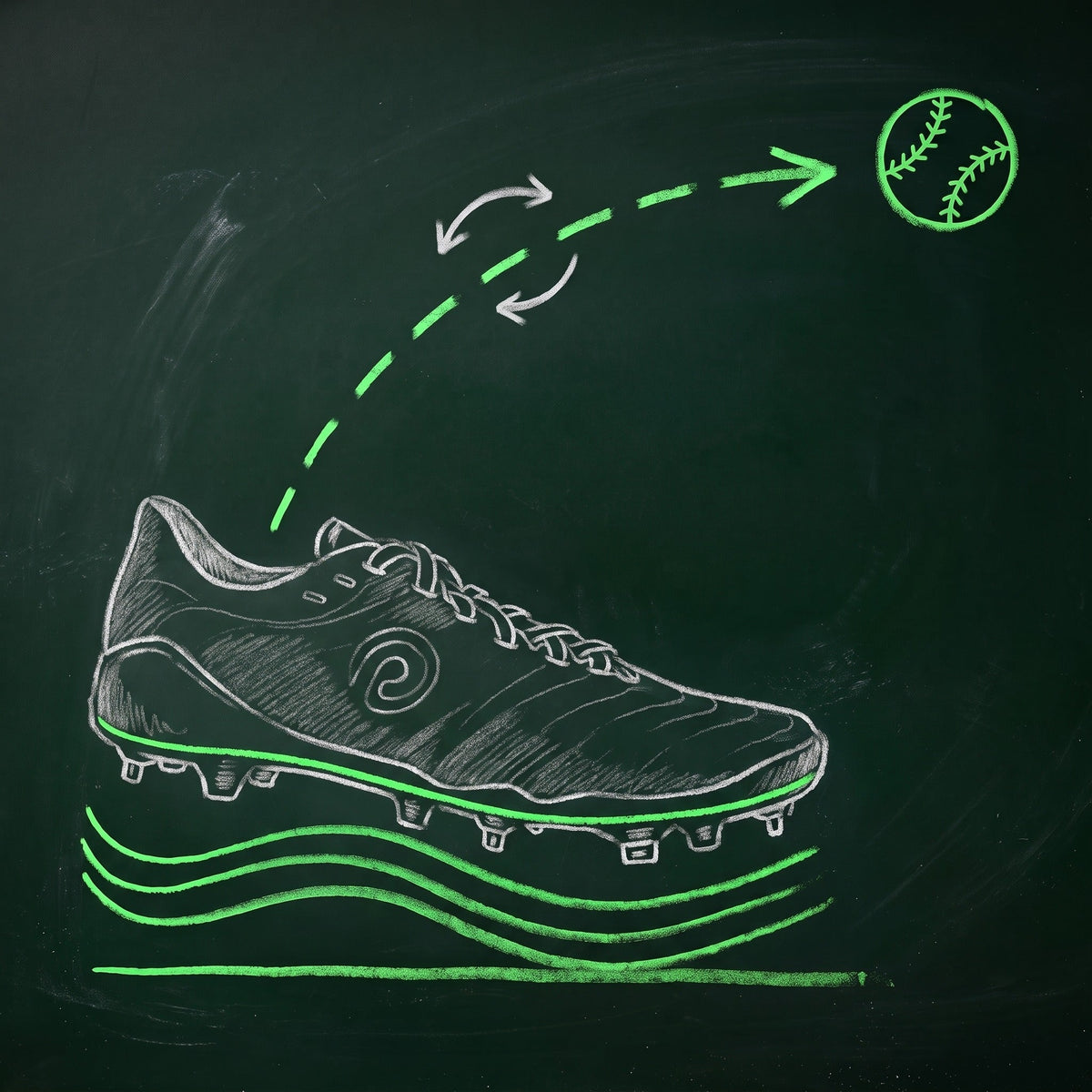
After a start, most pitchers take care of their arm with ice, bands, or a sleeve. Hardly anyone thinks about their front foot, even though it takes the landing on every single pitch.
A group at Hiroshima University looked at both. They tracked how a pitcher's landing foot changes over a full outing, and whether that lines up with what happens to the shoulder. It's a small pilot study with 15 players, but it's the first I've seen that followed the foot and the arm together, and what they found is worth knowing if you pitch or coach.
SHOP CUSTOM FIT BASEBALL CLEATS
What they did
Fifteen college pitchers each threw 60 pitches, split into three innings of 20 with ten minutes of rest between them. Most were fastballs, with some curveballs and changeups mixed in, roughly the mix MLB pitchers threw in 2019.
Before the first pitch and after each inning, the researchers measured how far the throwing shoulder could rotate inward. They also scanned the front foot in 3D to track its shape, and a force plate under the landing spot recorded how hard that foot hit the ground.
What happened to the shoulder
Inward rotation of the throwing shoulder dropped from about 45° to about 23° over the 60 pitches.
Some loss here is normal. Other studies have found around 18° after a game in college pitchers and around 10° in pros, and it usually comes back within a few days. It becomes a problem when a pitcher loses too much or throws again before it recovers, because that loss of rotation is linked to shoulder injuries.
What happened to the foot
The arch of the front foot sank a little more with every inning. Measured at the navicular, the bone near the top of the arch, standing arch height went from 39.7 mm to 35.1 mm, about 12% lower by the end. It stayed lower even when the pitchers sat down and took weight off it. Foot length and width didn't change at all.
The main muscle supporting the arch also changed. It's called the abductor hallucis and it runs along the inside of your foot from the heel to the big toe. It got stiffer as the outing went on.

How the foot and shoulder lined up
Pitchers whose arches sank the most tended to lose the most shoulder rotation. So did the pitchers who landed hardest, meaning the most downward force when the front foot hit.
That downward force didn't make anyone throw harder. Velocity tracked with a different force, the forward-to-back braking when the front foot plants. So landing hard seemed to cost shoulder range without adding speed.
When the researchers put everything into one model, landing force and the arch muscle stayed significant, but arch height on its own didn't. Put simply, it looks like how your foot handles the landing, again and again, matters more than how high your arch is.

What to keep in mind
This is a pilot study of 15 pitchers, and it shows a relationship, not proof that the foot causes the shoulder change. A hard landing could be behind both. The pitchers threw off flat ground rather than a mound, and their fastballs averaged about 68 mph. Nobody checked them the next day, so we don't know how long the arch took to recover.
They also couldn't wear cleats, because they were landing on a rigid force plate. The authors say that may have made the arch drop look bigger than it would on dirt. That's the part I'd most like to see tested again, since what a cleat does to that landing is exactly what we work on.
What the researchers suggest
The authors' suggestions are simple. Build endurance in the arch muscle with short-foot exercises, toe "rock paper scissors," and towel scrunches, so it holds up late in an outing and not just early. Work on cutting the downward pounding at landing while keeping the braking force that drives velocity; they mention keeping the front knee firm at landing. In the short term, arch taping, heel pads, or extra cushioning can help. And trainers could check arch height during the season, the same way they already check shoulder range.
How we think about it
We've written before about how a pitcher's feet matter more than most people think. That post looked at which players have weaker feet. This study adds a timeline: even healthy college pitchers' arches gave a little more with every inning.
No cleat has been tested against this, ours included. What we can do is build around it. Strength in the arch comes first, and our free foot strength level guide is a good place to start. Our metpads are built to get the arch working gradually as it gets stronger, rather than doing the work for it. For the landing itself, our pitcher plate uses a three-stud heel and a bar across the midfoot for stability. The pitcher we developed it with also asked for extra cushion, for recovery as much as performance. That story is in what each baseball position needs from a cleat.
Keep taking care of your arm. Just remember the throw starts with your feet.
SHOP CUSTOM FIT BASEBALL CLEATS
Tell us how your front foot feels
If you pitch, we'd like to hear from you. Does your front foot ache, cramp, or feel flatter late in an outing? Send us a message. We're gathering this for the next round of pitcher plate changes, and feedback from real pitchers is worth more to us than any lab setup.
Cheers,
Oliver
Founder
Prevolve Footwear