

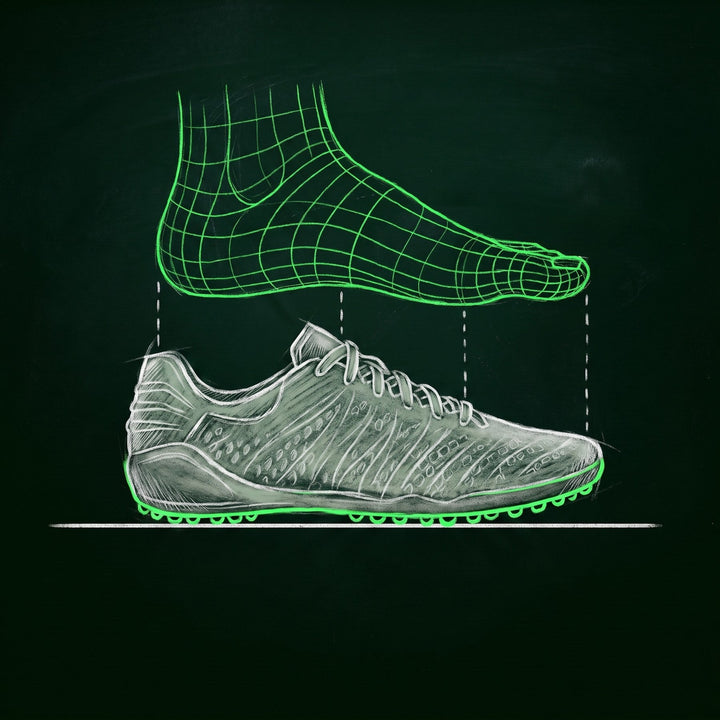
If you search for custom golf shoes, most of what comes up lets you choose colors, add your initials or put a flag on the heel. That's a fun way to make a shoe yours, but the shoe underneath is still the same stock size and shape as everyone else's. For a game where you're on your feet for four-plus hours, how it fits matters more than how it looks.
There are two kinds of custom. One changes the look, and the other changes the fit. Research on how well people's shoes fit their feet shows why the second kind is worth caring about, and it's the kind we build.
Form, function and fit
Footwear researchers judge a shoe on three things: form, function and fit. Form is how it looks. Function is whether it does its job, like gripping the turf through your swing. Fit is whether it matches the shape of your foot.
Most custom golf shoe programs work on form. You pick the leather, the colors and the details, and the shoe arrives in your usual size. Fit is harder because it means building the shoe around your foot, not a standard last, the foot-shaped mold a shoe is built on.
How many people wear shoes that fit
Two researchers at La Trobe University in Australia ran a systematic search and narrative review of every study they could find that measured people's feet against the shoes they were actually wearing. They found 18 studies, covering groups from older adults to underground coal miners.
Across the studies that checked both length and width, between 63% and 72% of people were wearing shoes that didn't match their feet in one or the other. Width was the bigger problem. In the median study, 58% of people wore shoes narrower than their feet, while one study found that only 1% wore shoes that were too wide.
A few of the results stand out for golfers. In a study of 176 older adults, with an average age of 80, 78% wore outdoor shoes narrower than their feet. In two studies of women aged 20 to 60, 86% and 88% wore shoes narrower than their feet, by an average of 0.9 cm and 1.2 cm. Some older people seemed to be buying shoes too long just to get enough width. The review also notes evidence that older people's feet are broader across the forefoot and flatter through the arch, which matters in a sport so many people play into their 70s and 80s.
Across the studies, badly fitting shoes were linked to foot pain, corns, calluses and changes in the shape of the smaller toes. Most of the studies were snapshots, so they show a link rather than proof of cause. They also measured fit in different ways, which is why the authors give a range rather than one number.

Why it happens
The authors are direct about the cause. Feet vary a lot from person to person, and the shoe industry builds from a limited range of lasts. A standard shoe can't match the three-dimensional shape of every foot. Their recommendations are better fitting education and more widths at every length.
We covered the width side of this in the widest golf shoes on the market. Wide sizes help, but a 4E is still somebody else's average foot made wider. Your foot isn't an average, and your left foot usually isn't the same as your right.
What custom fit means at Prevolve
Every Prevolve golf shoe is built from a 3D scan of your feet, starting the day you order.
You order, and scanning instructions land in your inbox. The scan takes a few minutes at home with your phone. We turn it into a 3D model of each foot separately: length, forefoot width at the widest point, arch profile, instep height, toe splay and heel shape. Our algorithm then shapes every part of the shoe to that model. We've spent over 10,000 hours coding it, and you can read how that file came together.
On your first order, we send you a 3D-printed Fit Sock first. It's a printed test of your exact geometry, and you wear it and tell us how it fits. We only go into production once you confirm it's right. Every part then prints within 24 hours, and the pair is finished by hand in our US workshop. Shoes ship 4 to 6 weeks from your order.
The fit goes past length and width. The sole, upper and heel are all 3D-printed TPU, shaped so your foot stays planted through the backswing, transition and impact instead of sliding around. The toe box follows the way your toes actually splay. The traction is placed using your foot's pressure map, so it sits under the parts of your foot you push from. Your weight tunes the base, and your foot strength level sets the insole plate and insole thickness, with more flex for stronger feet and a firmer plate for feet that are still building strength. Our free foot strength level guide explains each level.

You still get to choose the look. Every pair comes in Prevolve Green, Black Ice, White Out or a custom color, with Rubber Tread for most courses or replaceable Screw-in Spikes for wet and hilly ones.
What backs it up
Every pair carries three guarantees. The Fit Sock activates a 30-day fit guarantee: if anything still feels off after delivery, we adjust or remake your pair, with US shipping on us. If you don't love them, you can return them within 90 days for a full refund. If they break down inside 250 hours of play, your next pair is free.
Your scan also stays on file. When you want a new pair for next season or a different traction setup, there's no fitting to repeat, and reorders on an existing scan are 25% off.
Custom golf shoes as a gift
Because the scan happens after the order, custom golf shoes work as a gift. You order, and the golfer you're buying for gets the scanning instructions and does it from home. Pairs start at $635.
Your feet carry you for every hole you play. They should get a shoe built for them.

Tell us what your golf shoes get wrong
If you play, we'd like to hear from you. Where do your current golf shoes pinch or rub by the back nine? Have you ever bought a size longer just to get the width? Send us a message. We're also testing a new screw-in spike plate right now, and tester pairs are $250 off. Every bit of fit feedback goes back into the file that builds the next pair.
Cheers,
Oliver
Founder
Prevolve Footwear
Source: Buldt, A. K., & Menz, H. B. (2018). Incorrectly fitted footwear, foot pain and foot disorders: a systematic search and narrative review of the literature. Journal of Foot and Ankle Research, 11, 43. doi.org/10.1186/s13047-018-0284-z