

SHOP CUSTOM FIT FOOTBALL CLEATS
If you play football, you have probably been timed, weighed and tested more times than you can count. Almost nobody has measured your feet. At the top of the sport the gap gets extreme. NFL players get MRI'd, motion-captured, GPS-tracked and weighed in front of a national audience. Yet the one body part that touches the ground on every single play gets very little attention.
The feet inside those cleats are, by any reasonable guess, some of the widest and most heavily loaded feet on the planet. They are served by an industry that mostly manufactures one width.
Foot and ankle damage before the first snap
The numbers behind "hidden epidemic" are not ours. They come from the NFL Combine, the league's yearly medical and athletic evaluation of incoming players.
When researchers evaluated 320 players at the 2006 Combine, 72% had a history of foot and ankle injuries: 287 injuries across 231 players, including 115 lateral ankle sprains and 36 cases of turf toe. That is roughly one turf toe for every nine players. Offensive linemen came in at an 80% injury rate, and kickers, punters and special teams players at 100%.
A bigger study reviewed 2,285 Combine participants from 2009 to 2015. More than half (53.2%) arrived with a history of ankle injury. Of the players who had X-rays, 50.6% already showed signs of arthrosis, which is arthritis-type wear in the joint. That wear is visible on film in athletes around 22 years old who have not yet played a professional down.
These studies describe college careers, so the damage is already there before draft day, and a pro career starts on top of it. They do not say what caused those injuries. They show how much damage these players carry before the league ever sees them.
Why NFL feet are probably the widest in sport
There is no published survey of NFL foot width. Nobody has measured the league's feet and put the results in a journal, which is a striking gap for a sport this heavily measured.
The reasoning still points one way. NFL rosters carry the heaviest elite athletes in mainstream sport, with many linemen over 300 pounds. Feet scale with bodies, and feet that spend a decade under that kind of load and force production do not stay narrow. If anyone's feet sit in the wide tail of the human range, it is these players.
We do know how wide that range is, because someone measured the rest of us. An analysis of 1.2 million 3D foot scans found that among people wearing the same shoe size, foot width varies by about 16 mm across the middle 90% of the population. One stock width fits at most 40% of customers, and the study's authors found it takes at least three widths per length to cover 90% of people.

If one width covers only 40% of ordinary shoppers, it has little chance with a 320-pound tackle whose job is to drive another 320-pound man backward sixty times a night.
Why football cleats come in one width
The big brands are not staffed by villains. They are staffed by people who answer to an inventory spreadsheet. Every extra width means another last (the foot-shaped form a shoe is built on), another mold set and another size run sitting in a warehouse. So the industry converged on one width per model, graded up from a single template, using grading tables that the foot-scan researchers noted "haven't changed for decades."
When a "wide" version does exist, it is often the same shoe with a little more upper material rather than a shoe built on a genuinely wider platform. I wrote about that economic trap in Why Wide Cleats Don't Exist, and about what to look for in Football Cleats for Wide Feet.
The result is that the athletes with the most extreme feet in sport play in footwear designed around an average that fits fewer than half of ordinary people. Toes that want to spread and grip get folded into a taper on every play.
What a shoe can and cannot fix
Football is 300-pound collisions on grippy surfaces, and no cleat takes the collisions out of the game. Turf toe, for instance, is mostly a hyperextension injury: in a study of 80 professional players, 85% of turf toe cases came from hyperextension and 83% started on artificial turf. That paper points at synthetic surfaces plus overly flexible shoes, so maximum flexibility is not the answer either. Our position is that a cleat should bend where the toes bend and hold everywhere else.
What fit does control is the daily environment of the foot. Either the toes can spread to their natural width on every plant and cut, or they spend every practice and every game folded into someone else's average. Nobody has to accept that part of the problem, because it is a choice shoe companies made.
How we build football cleats
The fix is not a braver guess at widths. It is refusing to guess: scan the foot, then build the cleat around it.
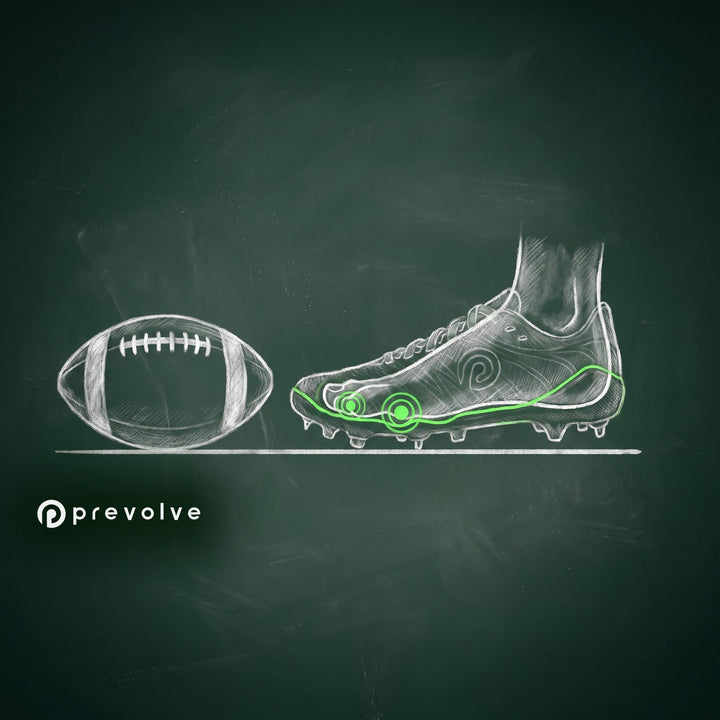
That is how every Prevolve custom football cleat is made. A 3D scan of each foot becomes the shape of each shoe. We build the left and right shoes separately, because left and right feet are rarely the same size or shape. Your toe box follows your own toe spread, and your studs are placed from your own scan. Every pair is also zero drop. With the heel at turf height and the little toe free to splay, I suspect a planted foot gets a lot harder to tip onto its outside edge, which is the exact motion behind a lateral sprain.
If you have spent your career being told your feet are "too wide," they were never too wide. The shoes were too narrow.

SHOP CUSTOM FIT FOOTBALL CLEATS
Tell us how your cleats fit
If you play football, we'd like to hear from you. Where do your cleats pinch or rub by the fourth quarter? Have you been told your feet are too wide, or sized up just to get the width? What position do you play? Send us a message. Your answers go straight into how we shape the toe box and lay out the studs for each position on the next pairs we build.
Cheers,
Oliver
Founder
Prevolve Footwear
Related: Why Hasn't Anyone Studied Barefoot Training for American Football? and how the foot scan works.