

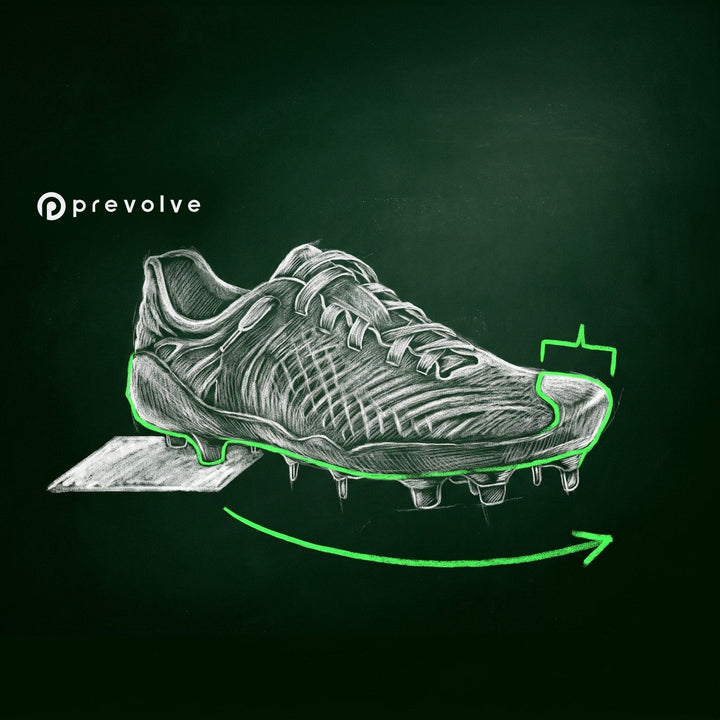
Most guides to cleats for pitchers treat a pair as one thing, but a pitcher's two feet do different jobs. The back foot pushes off the rubber and then drags across the dirt. The front foot lands and brakes the whole body. Good baseball cleats for pitchers and good softball pitching cleats have to suit both feet.
We spent more than a year building a Pitcher cleat around those two jobs with professional pitcher Travis Kuhn. Here's what a pitcher's feet need, how we built for it, and the retail pairs worth a look if custom isn't for you yet.
SHOP CUSTOM FIT BASEBALL CLEATS
Pitcher cleats start with the drag foot
A pitcher's drive foot leaves the rubber, rolls up onto its toe and gets pulled forward. During that drag the top of the toe box scrapes the dirt, which is why one shoe can wear through while the other still looks new. The drag foot is your throwing side, so a right-hander's right shoe takes the damage.

Travis Kuhn pitching for Jaguares de Nayarit in October 2026. His landing foot has planted and his back foot is up on its toe, about to drag.
Softball pitchers get the same wear by rule: under high school rules the pivot foot has to stay in contact with the ground until the front foot lands, so it scrapes on every pitch.
What the drive foot and landing foot need
Before it drags, the back foot has to push, and that push comes through the forefoot. The studs that matter most sit under the ball of your foot. On a retail plate they're placed for an average foot of your length, so if your foot is wider or shaped differently, you push through a stud in the wrong spot. The back ankle has to bend as you load too, and a study of 228 young players linked a stiff back ankle to arm injuries.
The front foot takes the bigger load. Force-plate work in baseball has it resisting about twice the horizontal force the back foot produces, and in softball the stride foot's peak vertical force averaged 139% of body weight in 53 youth windmill pitchers. That foot needs traction so it doesn't slide, and room for the toes to spread as the weight comes on. Over an outing, a pitcher's front-foot arch sinks, which is why I'd rather build a stronger foot than lock it in a stiff one.
How we built the Pitcher cleat with Travis Kuhn
Travis spent eight years pitching in the Mariners, Phillies, Tigers and Blue Jays organizations. He has tested every pair we've built for him and sent feedback on each one. In October he made his debut for Jaguares de Nayarit in the Mexican Pacific League in our cleats, and we're building his next pair now.

The first pair taught us the most. The spikes on the left foot were oriented the wrong way, and the heel spike sat far enough from the edge of his foot that he slipped on a couple of landings. He went back to his old cleats for a bullpen, and that told him something too: "I felt SO much less stable and anchored. The heel lift is so much more apparent and I don't feel nearly as locked in when not wearing our spikes."
The next pair fixed the spike orientation, moved the heel studs and stiffened the plate. The pair after that added cushion, because he was coming back from a shoulder injury and wanted, in his words, "not only prioritizing performance, but also day to day recovery." His verdict on that build: "by far the most comfortable pair we've had." The longer version of that story is in what each baseball position needs from a cleat.
In his words: "Backed by force tracking data and movement analysis, these cleats are by far the best performing cleats I've had my hands on - and I've tested over a dozen pairs from major and niche brands over the years."
Follow Travis on Instagram at @travisraykuhn, and see the full debut carousel on our Instagram.
What's in the Prevolve Pitcher build

Zero drop. Your heel sits level with the ball of your foot, the way it does barefoot. Nothing tips you forward onto your toes before you've started your delivery, and your landing foot comes down flat and close to the ground.
Stiffness set to the player. The plate under your foot isn't one stiffness for everyone. We set it from your weight and your foot strength level: stronger feet get a thinner, more flexible plate so the foot can do its own work, and developing feet get a firmer one while they build up. A 215-pound pitcher and a 150-pound one don't get the same plate.
A thicker insole. The Pitcher build carries a thicker insole than our other baseball cleats, and the shoe stays zero drop. That came straight from Travis. Pitchers stand, drive and land for hours, and recovery between outings matters as much as the outing itself.
Studs tuned for force and traction. Twelve metal blades: nine across the forefoot and three in a triangle at the heel. Each one is mapped to your metatarsal joints from your own scan and angled for the work it does, so the forefoot blades bite on the push off the rubber and on the brake when you land. The heel triangle moved out toward the edge of the foot after Travis slipped in his first pair. The extra blades are why the Pitcher build costs $20 more than our 7-stud option.
A toe guard on the drag foot. The guard is part of the plate and goes on your throwing side only. It's the part we've revised most: it got a little thinner and now runs back toward the midfoot along the inner side of the shoe. We expected a longer guard to stiffen the forefoot where it needs to bend. It didn't, so the guard got longer.
Every pair is built from a two-minute phone scan of each foot, and the fit is checked first with a 3D Fit Sock printed from that scan. The blades screw in, and a 12-pack is $24.50. If your drag shoe wears out first, you can order one replacement shoe instead of a new pair. The Pitcher build is $655, $755 or $805 depending on the size of your foot. Terms for the fit and durability guarantees are in the FAQ.
Other cleats for pitchers worth a look
Use metal on a dirt mound where your league allows it. Little League doesn't allow metal in Majors and below, and turf mounds call for turf shoes. Our Pitcher build is metal, so in a league that bans it, our molded FG Bladed is the custom option. Message us before you order if you drag heavily, since it doesn't carry the pitcher toe guard.
If you're buying off the shelf, these are the pairs I'd look at. Prices were checked on November 6, 2026.
- Youth or no-metal leagues. The UA Harper 11 RM Jr. is $45. Add a toe coating like Tuff Toe ($16 to $25), which Under Armour recommends for pitchers who drag.
- Baseball, metal legal. The New Balance 3000v7 metal ($89.98 to $109.99) has long been a pick for heavy draggers, with a wide 2E version. New Balance also recommends a toe coating.
- Softball. The Ringor Flite with Pitching Toe has a reinforced toe built in, at $120 molded or $140 metal.
When to make the switch
Going from a raised, stiff retail cleat to a flat, flexible one asks more of your feet and calves, and that takes a ramp. Winter is the time for it. Do the foot work first, wear the new pair for bullpens well before a start, and treat pain as the signal to slow down. Not every injury is preventable, and the foot is a skill you have to train. Mid-season, the week before a big start, is the wrong time to change anything on your feet.

SHOP CUSTOM FIT BASEBALL CLEATS
Show us your drag toe
If you pitch, send us a photo of your drag shoe. Tell us what you wear, how many innings it took to get there, and whether you play baseball or softball. We'll use those wear patterns to decide the next toe guard revision. We developed this plate on baseball mounds, so we especially want to hear from softball pitchers about where the circle wears a shoe down.
Cheers,
Oliver
Founder
Prevolve Footwear
Source: Guido JA Jr, Werner SL, Meister K. (2009). Lower-extremity ground reaction forces in youth windmill softball pitchers. Journal of Strength and Conditioning Research, 23(6), 1873-1876. doi.org/10.1519/JSC.0b013e3181b42535