
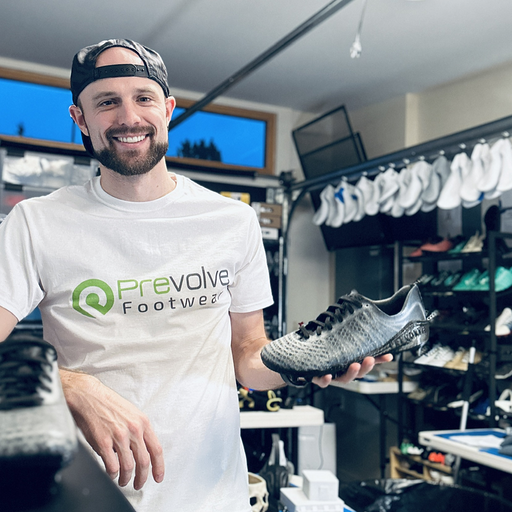

Common advice for tight cleats is to try a 2E width, go up half a size, or wait for the upper to soften.
Those suggestions address different problems. A wider upper, extra length and a softer material aren't interchangeable fixes.
I've been designing and 3D printing cleats for most of the last decade, and I have wide feet. I play soccer; my experience here comes from designing for football players and reviewing their feedback.

SHOP CUSTOM FIT FOOTBALL CLEATS
The right length can still be the wrong width
"Wide feet" sounds like a vague complaint until someone measures it. Our scan vendor did, at scale. Across 1.2 million scanned feet, people inside a single length class differ by about 16 mm in forefoot width across the middle 90% of them, and by 43 mm once you include everyone. Same size on the box, a substantial difference across the ball of the foot.
The same paper says one stock width fits at most 40% of those feet, and that covering 90% of them would take at least three widths at every length. That makes the available width options worth checking when you compare models.
A player can wear the right length and still need a different width.
Check what changes in the wide version
Every cleat is built around a last, the solid 3D form that defines the space inside the shoe. The last decides the toe box shape, the width across the ball, the depth over the instep, how the heel is cupped. The shoe is formed around it and then the last comes out.
A wide label doesn’t tell you which dimensions changed. Compare the upper, toe-box shape and plate with the standard version. I explain the manufacturing choices behind width options in Why Wide Cleats Are Hard to Find.
Sizing up adds length as well as room. Check whether that leaves the heel moving or the foot sliding forward, rather than assuming a larger size solves the fit.
Adjusting the laces may change pressure over the foot, but check that the foot still feels secure when you move.
What to check by position

Linemen. We pay particular attention to forefoot width and how the build holds during loaded movements. Fit and plate stiffness need to be considered together.
Running backs and fullbacks. The fit needs to hold through planting and cutting, with enough room across the forefoot.
Receivers and defensive backs. Players with wide feet need to check fit just as carefully. A position label doesn’t tell you what shape your foot is.
Youth and high school. Growing feet need regular fit checks. Replacing an outgrown pair is also a chance to reconsider width, rather than automatically buying the next length.
Match the plate to the foot
We consider plate width alongside the shape inside the upper. A custom build lets us adjust that platform to the player rather than selecting it by length alone.

The plate decides where load lands, and that is measurable. A Duke lab put 36 athletes through side cuts and cross cuts on FieldTurf in four different cleat plate configurations and found significantly different forefoot loading patterns between the plates, enough that the authors argued for more forefoot cushioning in cleats generally. The pressure distribution changed with the plate configuration.
I care about release as well as grip. A 1996 observational study of high-school football players linked one high-traction plate design with more ACL injuries. It does not settle the choice for a modern cleat, but it reinforces my view that maximum grip is not the only design goal.
We use the scan to guide plate shape and stud placement, then consider the playing surface. Football builds come in four plates: AG conical and AG bladed for artificial turf, FG conical and FG bladed for firm natural grass. We discuss the traction and release characteristics of each option during plate selection. If you train and play mostly on turf, the AG plates keep the stud shorter so you sink and catch less.
I wrote up the placement argument in more detail in why stud placement matters. It explains the design approach in more detail using soccer plates.
The forefoot has to bend. The plate still has to hold.
I want football players training their feet, not just finding a wider place to put them. In a study of 17 collegiate football players, toe-pushing force was associated with agility-test times. Foot strength and control deserve a place in training.
That's why I design for forefoot movement and choose the stiffness around the player. I want useful movement with enough structure for the job.
A heavier player needs the plate to hold under load, and the toe joints need protection as well as freedom to move. I take both seriously. Barefoot training is how we work on the foot; the cleat still has a job to do on the field.
We consider your weight, position and foot strength when setting the internal plate and stud wall thickness. The foot strength guide explains our training approach. For the research specific to this sport, see the barefoot football training article.
What "custom" actually means here
Two different things get sold under that word.
Aesthetic customization is picking colors on a configurator. Your foot is not in the loop, and the last is the one everybody else gets. If the shape was wrong for you at retail, it is still wrong in your team colors.
Fit customization is when the last itself is generated from your foot. That is what we do. You scan your feet (the process is on the foot scanning page), we take your weight, position and foot strength, and our design algorithm builds a last, a toe box, a stud layout and a plate stiffness for that specific foot. Then it gets printed. Nothing is pulled from a bin of pre-made sizes.
Printing to order lets us incorporate design revisions without waiting for a new set of production molds.
The football cleat product page lists current prices and configuration options. Toe spacers and metpad insoles are also available. The FAQ explains the current fitting process and guarantee terms.
If you are buying off the shelf this season
Custom is not the right move for everyone, and a kid who will grow two sizes by spring is a fine reason to buy retail. Here is what I’d check in the store:
- Inspect the plate. Compare the wide and standard versions to see whether the platform changes as well as the upper.
- Compare the shape. Look at toe-box taper, heel fit and forefoot room together. A width label can’t describe all three.
- Compare flex. Bend the forefoot gently to compare models. A hand check is a comparison, not a measurement of how the cleat will behave in play.
- Match the plate to your field. Check that the intended playing surface matches where you train and compete.
- Try them on late in the day, in your game socks. Feet swell, and the store's tile floor is not a three-point stance.
- Check length and width together. If getting enough width leaves the heel loose or the cleat too long, compare another shape.
Check the whole shape: forefoot, heel and plate. If the same fit problems return each season, record where they occur so the next fitting can address them.
We build the shape from your foot scan, then adjust the plate for your position and playing surface.