
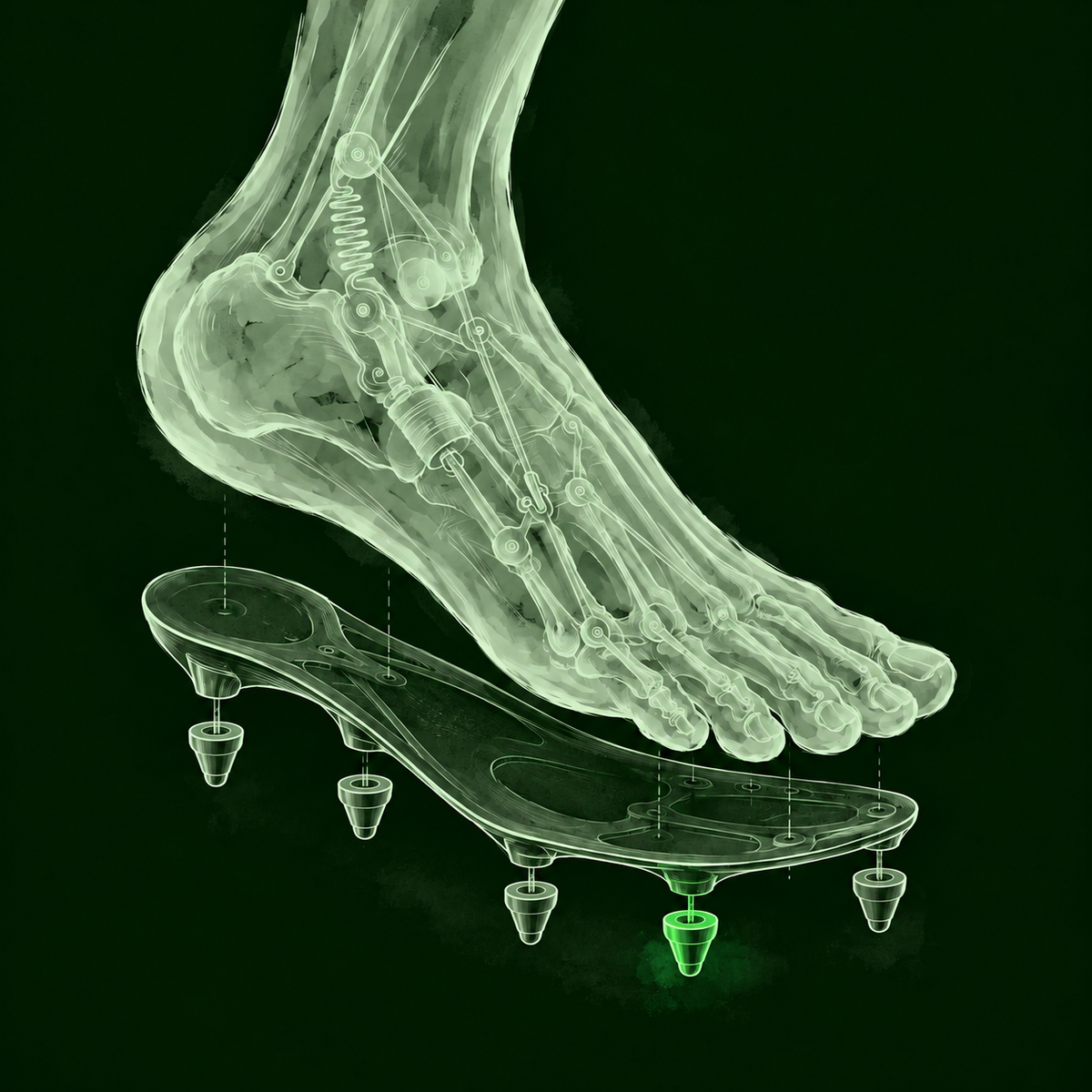
Almost every stud conversation I see online is about shape. Conical or bladed. FG or AG. Which one is faster, which one bites harder, which one the pros are wearing this season.
Placement deserves as much attention as shape. I want to know how the stud layout relates to the foot inside the cleat.
I’ve played for 25 years, and I design, print and sell these soleplates.
I want to keep playing as I get older. That influences the choices I make about fit, traction and plate structure.
This article focuses on stud placement, traction and plate structure. The soccer cleat comfort article walks through the fit of the whole cleat, and the cleat is one of the most important part of soccer training gear.

What actually pushes on the ground
The forefoot, toes and heel are landmarks we consider when designing the plate. The fit illustration compares the foot with the platform beneath it.
Your toes participate when you balance and push off. Pressure measurements show how much contact and load they carry during stance. As a designer, that is a reason to pay attention to the foot itself before arguing about the shape of the studs.
Our design goal is a plate that holds the studs securely while allowing movement where we intend it to bend.
Where a stud should sit
A 3D foot scan records the external shape of the foot. We position studs relative to the forefoot and heel landmarks we use in the design. The phone scan doesn’t image internal bones.

Our revisions include adjusting forefoot and heel stud positions, rounding the junction where a stud meets the plate, and shortening some bladed studs. We refine those details as the design develops.
The plate built for an average foot
The alternative is a plate drawn around an average foot, which puts studs where an average foot's bones are.
Foot shape varies within a length category. Across 1,200,847 scanned feet, people wearing the same length varied by about 16 mm in width, and the paper estimated that a single stock width could fit at most 40% of the feet in a length class. Length alone can’t describe that variation.
If your forefoot is wider than the plate, the mismatch deserves a closer look during fitting. We use the scan to adjust the shape instead of assuming that one standard platform will suit every foot at that length.
I have wide feet, and I spent years playing in cleats that felt narrow. I’m not interested in accepting that mismatch as normal. We build the plate around the foot.
Stud shape is a trade, not an upgrade
Once studs are in the right places, shape decides how they behave in the ground. The product options distinguish firm ground, artificial ground, soft ground and indoor surfaces. For how the overall cleat should fit, see the comfort post.
Round and bladed studs behave differently, but shape alone doesn’t settle the choice. Surface, layout, dimensions and the rest of the cleat also matter.

Shape also moves the load around inside your cleat, which is worth considering alongside grip. 29 amateur players ran straight and cut at 60 degrees on turf in bladed and studded cleats from the same manufacturer's range: the studded cleats put more peak pressure under the medial half of the foot, the bladed cleats under the lateral half. The result concerns those two models on that surface. It is a useful reminder that a plate changes what happens inside the cleat as well as underneath it.
A review of the Essen lab’s soccer footwear studies examined cleat features in relation to kicking speed. In those tests, traction under the plant foot mattered, while shoe weight and outsole stiffness didn’t change kicking speed. It is another reason I care about the plant foot when designing the plate.
Grip needs to suit the movement
More grip isn't automatically my goal. I want enough traction for the movement and a setup that suits the surface. A foot that can plant securely also needs to change direction.
In a lab study of ten athletes, changing rotational traction changed ankle and knee loading during cuts. Injury research in American football also found an association between higher measured traction and injury. These findings inform how I think about the trade-off; they do not establish one ideal stud for everyone.
Grip, release and foot movement need to work together. I want a cleat that helps the player keep moving well, not one that wins a single traction test.
The plate is a structure
Studs are the visible part. The plate they sit on decides whether they do anything.
Three design choices matter here. We choose the plate thickness, place flex grooves and internal notches, and adjust stud wall thickness for the build. The purpose is to balance how the plate holds its shape with where it can move.
Stiffness needs a more precise discussion than whether it matters at all. Plate flex and stud movement are different parts of the construction, and I consider both when reviewing a build.
A flexible section allows movement; another part may need to hold its shape under load. The task is to decide where each behavior belongs.
We ask for a foot strength level as part of that process. It helps inform the build alongside weight, position and playing surface.
The barefoot training article explains the other half of that approach. I want you developing the strength and control to use your feet well, alongside a cleat that fits.
What to actually check
Most of this you can run tonight, on cleats you already own.
- Compare the fit. If the insole is removable, compare its outline with your foot as an initial check. Inspect the outsole separately; an insole comparison doesn’t measure the plate.
- Find the crease. Bend the cleat at the forefoot and see where it folds. That fold should land on the joints behind your toes, not out under the middle of them and not back in the arch.
- Compare resistance. Bending the cleat by hand can help you compare models, but it doesn’t tell you exactly how the plate will behave during play.
- Inspect the studs. Look for visible damage or looseness and ask the manufacturer about anything that concerns you.
- Match the setup to your playing surface. Discuss traction and release as well as grip when choosing the plate.
If you haven't found a standard plate that fits your foot, a scan gives us a starting point for a custom design. Stud shape, placement and plate structure are all choices we can work through from there.
Daniel Pena is a long time soccer coach and trainer. You can find more of his work at the Art of Football Blog and his coaching site, Coach Daniel PT.