
When the season ends, most ballplayers and parents start thinking about arm care: rest, then bands, long toss and a throwing program. The ankles rarely come up, even though every throw starts with the back foot loading into the ground.
A group of orthopedic surgeons at Gunma University in Japan checked both. Before the season, they measured the shoulders, elbows and ankles of 228 young players, then followed them to see who hurt their arm. The back-leg ankle turned out to be one of the strongest predictors in the study. It's also something a player can work on all winter.
SHOP CUSTOM FIT BASEBALL CLEATS
What they did
The surgeons run free preseason check-ups for youth players in their region. For this study they enrolled 228 players aged 7 to 12, none of whom had hurt their throwing arm before. Each one had their shoulder, elbow and ankle movement measured with a digital protractor, and their shoulder strength tested with a handheld gauge.
Through the season, the players kept a daily diary of any shoulder or elbow pain and whether it stopped them throwing. The researchers counted an injury when a player couldn't throw for 8 days or more because of a shoulder or elbow problem. Injuries from being hit by a ball, collisions or falls didn't count.
Who got hurt
Forty-three players, about one in five, had a shoulder or elbow injury during the season. Most were elbows: 32 elbow, 7 shoulder and 4 both.
The injured players were a little older and bigger, averaging 11.0 years old against 10.2 for everyone else. Position mattered a lot. Ten of the 24 pitchers got hurt, about 42%, compared with 24 of 177 fielders, about 14%. Catchers sat in between. Injured players also had less rotation in their throwing shoulder, which matches what other studies have found.
What the ankles showed
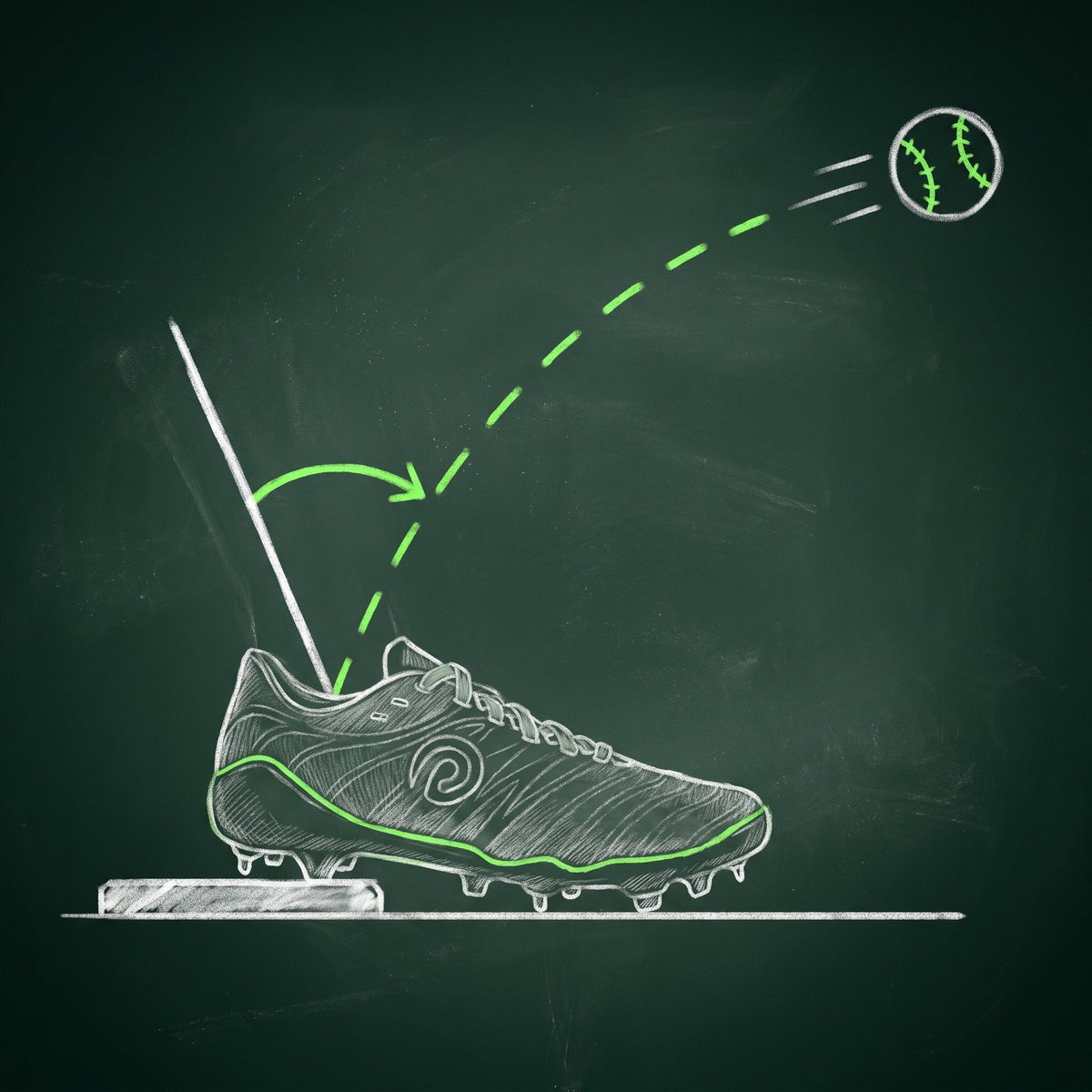
The ankle measurement that mattered most was dorsiflexion, which is how far your ankle bends to bring your toes up toward your shin. It's the motion your back ankle goes through as you load onto the back leg and then drive toward the target.
In the back leg, the injured players had about 19° of dorsiflexion and the healthy players had about 23°. The injured players could also point their toes down less in both ankles.
Plenty of things differ between injured and healthy players. So the researchers put age, position, shoulder and elbow movement, shoulder strength and the ankles into one model at once. Back-ankle dorsiflexion still came out as a significant risk factor on its own. Every extra degree of movement went with about 6% lower odds of injury. Across the 3.6° gap between the two groups, the authors calculated about 19% lower odds.
They also tested how much each measure was holding up the model. Taking out the back ankle weakened it more than taking out anything else, including whether a player was a pitcher.

Why the back ankle
The authors' explanation is about the kinetic chain, the way force moves from the ground through the legs and trunk into the arm. Between the windup and cocking the arm, the back ankle has to bend forward so the body can load and move toward the target. If it can't bend far enough, some of that energy may never make it up the chain. The shoulder and elbow then have to make up the difference.
They add that other studies have linked dorsiflexion to dynamic balance. Poor balance on the back leg would cost energy the same way. They're clear that both explanations still need testing.

What to keep in mind
The players were 7 to 12 years old and all from one region of Japan. We don't know how well this carries over to high school, college or pro players. It shows a relationship, not proof that a stiff ankle causes arm injuries. The ankles were measured with players lying on their backs while the examiner moved the foot. That isn't the same as a loaded ankle during a throw. Pitch counts weren't tracked, and they matter a lot at this age. The injuries were likely mild, since nobody needed surgery.
The study also didn't test whether improving ankle range lowers injuries. That's the obvious next step, and one I'd like to see.
What the researchers suggest
The authors say ankle range of motion should be part of injury-prevention programs for young players, alongside the shoulder and elbow checks that are already common. A 2025 clinical review of how to evaluate pitchers makes the same point from the treatment side. It lists limited dorsiflexion and a stiff big toe as common problems in pitchers. To restore ankle range, it recommends hands-on mobilization from a therapist plus self-mobilization at home.
If you want a quick way to compare your two ankles at home, the knee-to-wall test is a common one. Stand facing a wall with one foot a few inches back. Keep your heel flat and see whether your knee can touch the wall. Move the foot back until it can't, and compare left and right. A big difference between sides, or a back ankle that barely moves, is worth showing a physical therapist or athletic trainer before the season.
How we think about it
We've written about how a baseball player's feet matter more than most people think and how a pitcher's front-foot arch drops over an outing. This study adds the back leg, and it adds a timeline that suits the off-season. Ankle range and foot strength both take weeks to build, so winter is when to start.
Start with the feet themselves. Our free foot strength level guide shows you where your feet are and how to build them. The level you pick also sets the flex of your cleat plate. Stronger feet get a thinner, more flexible plate so the foot can do its own work, and developing feet get more support while they catch up.
The cleat matters too. Every Prevolve baseball cleat has 0 mm heel-to-toe drop. Your heel sits level with the ball of your foot, the way it does barefoot. Our foam heel collar is shaped around the curve of your Achilles, so your heel stays locked in while the tendon stays free to work. The studs are placed under your metatarsal heads from your own scan, so when your back foot loads, it loads through bone. Each foot is built from its own scan, which is useful when one ankle and one foot don't move like the other. The full build is on our custom baseball cleat page, and the position-by-position breakdown is in what each baseball position needs from a cleat.
For parents, this study was done on 7- to 12-year-olds, which is exactly who our custom cleats for kids are for. Feet under 22 cm get the Kids price, there's no minimum size, and a growing foot can be re-scanned for free.
Keep doing your arm care this winter. Just give your ankles the same attention.

SHOP CUSTOM FIT BASEBALL CLEATS
Tell us about your back ankle
If you play or coach, we'd like to hear from you. Has anyone ever checked your ankles at a preseason physical? Does your back ankle feel tight when you load on the rubber or in your batting stance? Send us a message. We're collecting this for the next round of changes to our heel collar and youth builds. What players actually feel tells us more than any measurement.
Cheers,
Oliver
Founder
Prevolve Footwear
Source: Shitara, H., Tajika, T., Kuboi, T., et al. (2021). Ankle dorsiflexion deficit in the back leg is a risk factor for shoulder and elbow injuries in young baseball players. Scientific Reports, 11, 5500. doi.org/10.1038/s41598-021-85079-8
Also cited: Gauthier, M. L., Unverzagt, C. A., & Davies, G. J. (2025). Evaluation and treatment of baseball pitchers: there's more to assess than the arm. International Journal of Sports Physical Therapy, 20(1), 113–126. doi.org/10.26603/001c.127461