
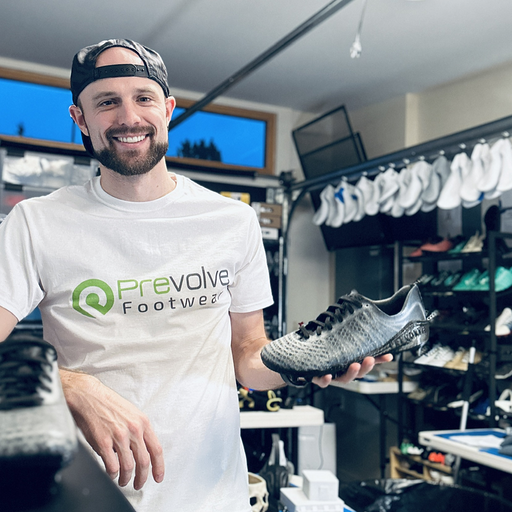

The usual suggestions for wide feet are familiar: try a 2E size, choose leather, size up, or give a tight pair time to soften.
Those suggestions change different things. Upper volume, material stretch and extra length aren't interchangeable solutions to a width problem.
I've been designing and 3D printing cleats for most of the last decade, and I have wide feet. Offering more widths means paying for more tooling and carrying more stock. That helps explain why finding the right shape can be difficult.
Printing to order gives us a different way to approach that problem.
I play two or three times a week, and I'd like to keep doing it at sixty. I believe keeping the feet strong, mobile and involved in the movement is part of that. The cleat should give them room to do it.

One length doesn't mean one width
A study of 1,200,847 in-store foot scans found substantial variation within length classes. In the 270 mm example discussed in the paper, the middle 90% span 15.8 mm in forefoot width; the full spread is 43.1 mm. Those are differences between people in the same length category.
The paper also considers how many widths are needed to cover that variation. One stock width fits at most 40.1% of those feet. Covering 90% takes at least three widths at every length.
A review of shoe-fitting studies found that 63 to 72% of participants wore shoes that didn’t match their foot length or width. Length, width and shape all deserve attention when fitting a shoe.
The last, the mold and the stockroom
A last is a solid form, usually plastic, shaped roughly like a foot. The upper is stretched around it, the sole goes on, and then the last is pulled back out leaving the upper formed around it. It decides the toe box, the width across the ball, the depth over the instep, how the heel is cupped. The last sets much of the fit.
Conventional production uses lasts for different sizes and molds for the soleplates. Adding another width can mean additional tooling before production begins.
One model in twelve lengths has twelve size combinations. Offer each length in three widths, and you have 36 size-and-width combinations per colorway. Each additional width means another set of sizes to produce, stock and forecast.

Tooling and inventory help explain why offering more widths is a significant manufacturing decision. It isn't physically impossible to make a wide cleat; it requires a different commitment of resources.
Why toe-box shape matters
Toe-box design involves fit, manufacturing and appearance. These are the trade-offs I consider.
Holding the foot securely. More room is useful only if the rest of the cleat still holds the foot securely. A wider design has to address both.
Making and assembling the shoe. The upper is formed around a last, which then has to be removed. We assemble our pairs by hand, and our process lets us work with shapes that differ from standard size categories.
Appearance. A pointed cleat looks fast. I won’t pretend otherwise. I just can’t look at one now without thinking about ten seasons of it.
Your toes need room to spread, feel the ground, balance and push off. I believe those abilities are worth preserving and training, not squeezing out to make a shoe look faster.

Room is part of the setup. So are toe spacers or toe socks when they suit the player, and regular foot training. My goal is a comfortable cleat around a foot that is getting more capable.

What changes in a wide size?
Width is not one measurement. It is at least three: heel, midfoot and toe box. A player can have a narrow heel and a wide forefoot, which is why those dimensions need separate attention.
Check whether the wide version changes the plate and toe-box shape as well as the upper volume. The label alone doesn’t tell you how the forefoot, instep and heel differ from the standard model.
Sizing up adds length as well as room. Check whether your heel stays secure and whether your foot slides forward. A stretched leather upper doesn't tell you whether the plate underneath is wide enough. Compare the whole shape rather than relying on the size label or material.
What I’d buy off the shelf
Custom is not right for everyone, and a kid who will grow two sizes by spring is the obvious case. Here is the checklist I’d use in a shop, in order.
- Inspect the plate. Compare the wide and standard versions to see whether the platform changes as well as the upper.
- Compare the shape. Look at toe-box taper, heel fit and forefoot room together. A width label can’t describe all three.
- Compare flex. Bend the forefoot gently to compare models. A hand check is a comparison, not a measurement of how the cleat will behave in play.
- Try them on late in the day, in your game socks. Feet swell, and a shop floor is not a match.
- Check length and width together. If getting enough width leaves the cleat too long or the heel loose, compare another shape.
Availability changes by model and size. Ask what dimensions change in the wide version, check the intended sport and surface, and confirm current sizing and lead times with the manufacturer.
Written up for your sport: soccer, football, rugby, baseball and lacrosse.
When custom is worth the money
Two different things get sold under that word. Picking colors on a configurator is one, and your foot is nowhere in that loop. If the shape was wrong for you at retail, it is still wrong in your school colors.
The other kind starts at the last. You scan your feet (the process lives on the foot scanning page) and send photos showing your toe structure and the gaps between your toes. Our design algorithm generates the last, the toe box, the stud layout and the plate stiffness for that foot, using your weight, position and foot strength to decide how much structure goes under you. Then it gets printed. Because there is no mold to pay off, the design moves month to month instead of season to season.
This is the far end of it. That customer's foot is 230 mm long and 115 mm across the forefoot, half the length of the foot.

The shape follows the measurements, even when the result looks unusual. That's the point of building for an individual foot.
The custom cleat collection lists current models and prices. The FAQ explains production timing and the fitting process. The foot strength level guide covers our approach to training and adaptation.
What to check when you shop
- Length is only one measurement. Compare forefoot room, instep volume and heel fit.
- Ask what the wide label changes. Look at the upper, toe box and plate.
- Check the whole fit. Extra toe room should not leave the heel loose.
- Consider custom when standard shapes keep missing. A scan gives us measurements to build from.
Wide cleats are difficult to shop for partly because the options are organized around size categories. Our approach starts with the shape of the foot that will wear the shoe.